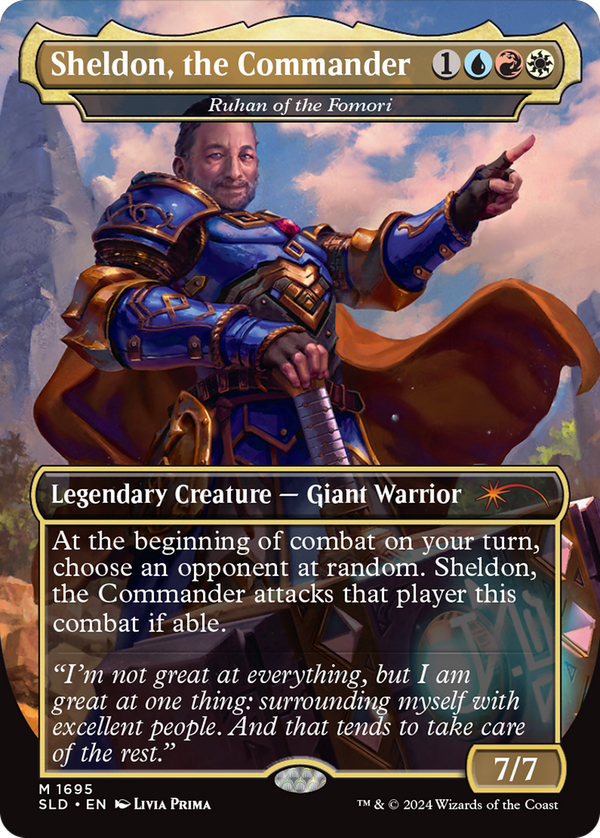
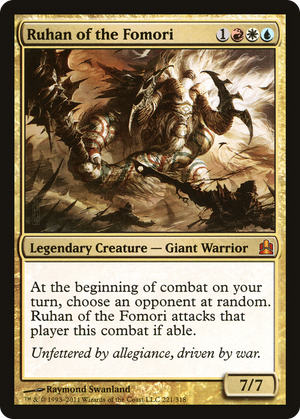
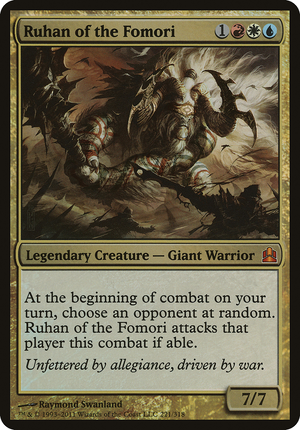
Ruhan of the Fomori




A 7/7 for four mana that comes with a leash you do not hold. The randomized attack trigger is the card's entire design proposition: you get a genuinely undercosted body, and in exchange you surrender the most basic agency a creature gives you, the ability to point it. Each combat, the dice decide which opponent eats the swing, which means the player you most want dead and the player about to combo off have equal odds of being the one who takes seven. This was a deliberate experiment in multiplayer-only chaos, a creature that only makes sense at a table of three or more, where the randomness becomes a politics engine rather than a coin flip. Threatening every opponent equally turns out to be a strange kind of deterrence: nobody can buy peace with you, because you cannot promise where the attack lands. The build-around tension is obvious and well-trodden by now: pair the body with effects that let you choose targets anyway, with redirection, with extra combat steps that reroll the choice, or with goad-adjacent tools that punish whoever the trigger names. Left alone, it is a fast clock attached to a slot machine. The reward for accepting that bargain is a four-mana commander that closes games in three swings, which is fast for a color identity better known for control than for racing.