Rootwater Depths
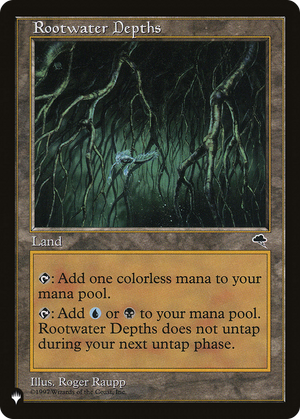
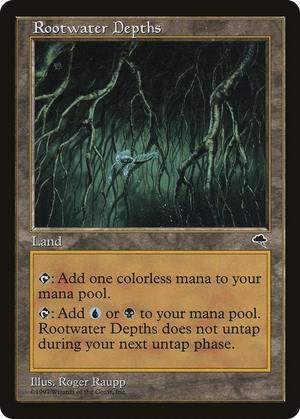
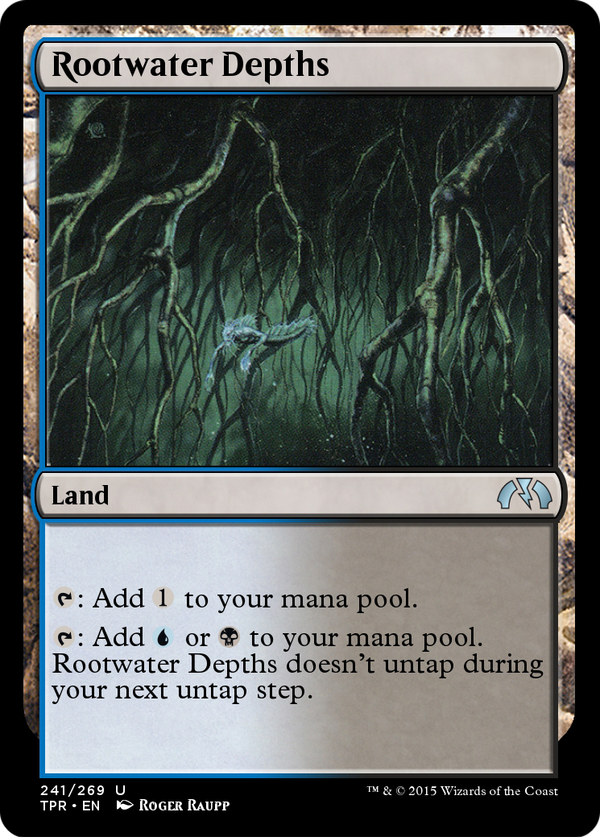
Tempest's contribution to the "you can have your color, but it costs you a turn" school of dual land design. The split is the whole idea: tap it for colorless and it behaves like any unremarkable land, but reach for the Dimir colors and it skips the following turn's untap, charging a tempo tax against the fixing. That friction is what kept the rate honest in an era before the painlands and shocklands made untapped dual mana cheap. Tapping for colorless is the safety valve, a way to use the land on a turn you cannot afford to lose it, which makes the card a small sequencing puzzle every time it enters play rather than a free two-color source. It anchored a five-land cycle, one per allied color pair, and the design template (untapped colorless, or the right colors at the cost of one untap) shows how much restriction Wizards once layered onto fixing that today reads as below-rate. The lesson the cycle teaches is structural: a dual land's power is set less by which colors it makes than by what it asks of your untap step.
Rules text
 : Add
: Add  .
: Add
.
: Add  or
or  . This land doesn't untap during your next untap step.