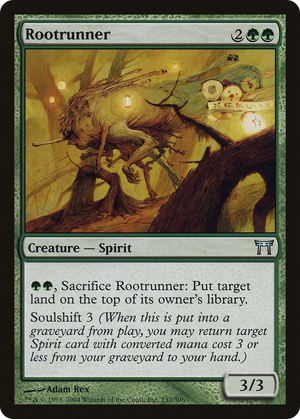
Rootrunner


Land destruction in this era usually meant breaking a land for good; this Spirit instead picks up a target land and buries it on top of its owner's library, a softer denial that costs the opponent a draw step and a tempo beat rather than a permanent. The owner draws that land right back next turn, so the disruption is a one-turn stall rather than a real two-for-one, which is exactly why the activation has to earn its keep some other way. Soulshift 3 is where it does. The sacrifice cost gives you an on-demand way to feed the creature to its own death trigger, and that trigger reaches back to recover a small Spirit (mana value three or less): the two abilities are not at odds, they are a closed loop. You spend the Rootrunner to set an opponent back a turn, and the same act of spending it returns a cheap Spirit to your hand. In a tribe dense with three-drops and below, the land-tuck stops reading as a beatdown plan and starts reading as a recursion engine that happens to inconvenience the opponent on its way around. It is green denial for a graveyard-hungry deck, where stranding a land is the excuse to trigger the part of the card that actually generates value.
Rules text
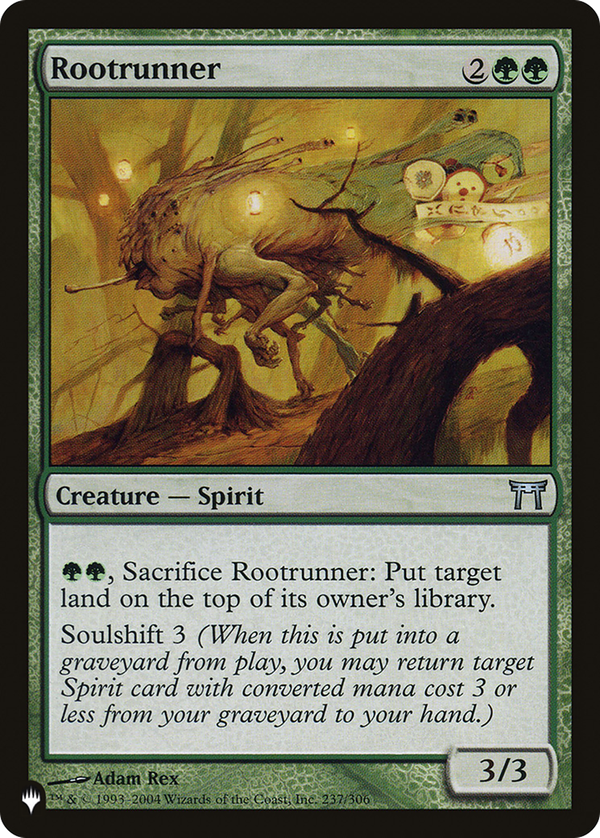
, Sacrifice this creature: Put target land on top of its owner's library.
Soulshift 3 (When this creature dies, you may return target Spirit card with mana value 3 or less from your graveyard to your hand.)