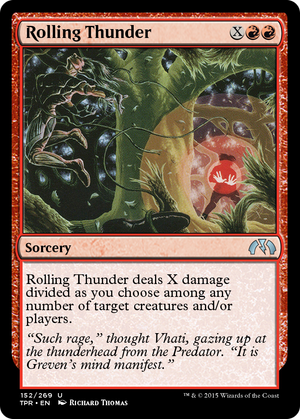
Rolling Thunder


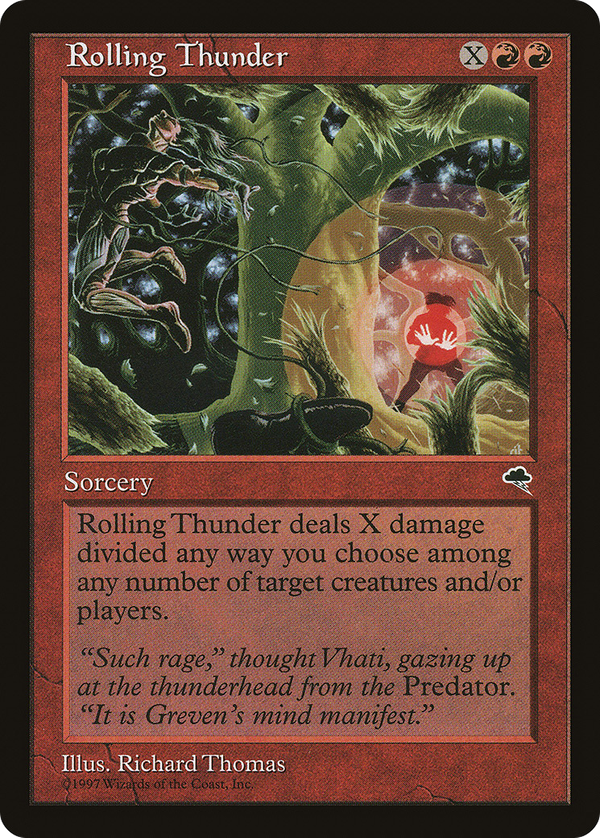
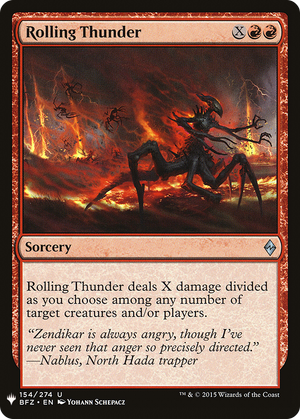
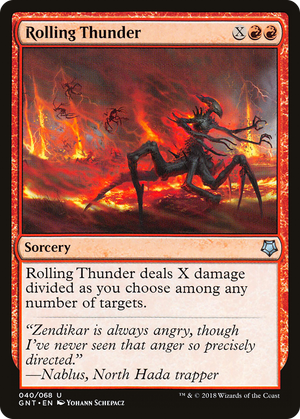
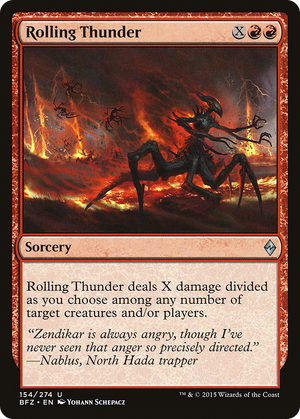
The freedom of the division clause is the whole design: the damage pool spreads across any number of targets, with no requirement to use more than one and no penalty for piling the entire pool onto a single creature or player. The one governing rule (each chosen target must receive at least 1 damage) makes the arithmetic real but generous, and that flexibility is what separates this template from sweepers that hit everything equally. Dividing as you choose collapses two roles into one card: a finisher when you point the whole pool at a face, and a precision board-clear when you parcel it out to kill several small bodies at once. The arithmetic is the tension, and it is front-loaded: targets and the split lock in as the spell goes on the stack, so the live decision happens at announcement rather than on resolution. Every point assigned to a creature is a point that will not reach the opponent, and once committed it cannot be reallocated if the board shifts before resolution. The sorcery-speed restriction does the balancing work here: it cannot ambush an attacker, cannot answer a combat trick, cannot be held up as a reactive threat. That places it in the lineage of variable-damage spells alongside Fireball, the single-target ancestor; the divide-among-any-number wording is the version that has proven most reusable, recurring across red's catalog whenever a set wants one card that can both close a game and clean up a board.