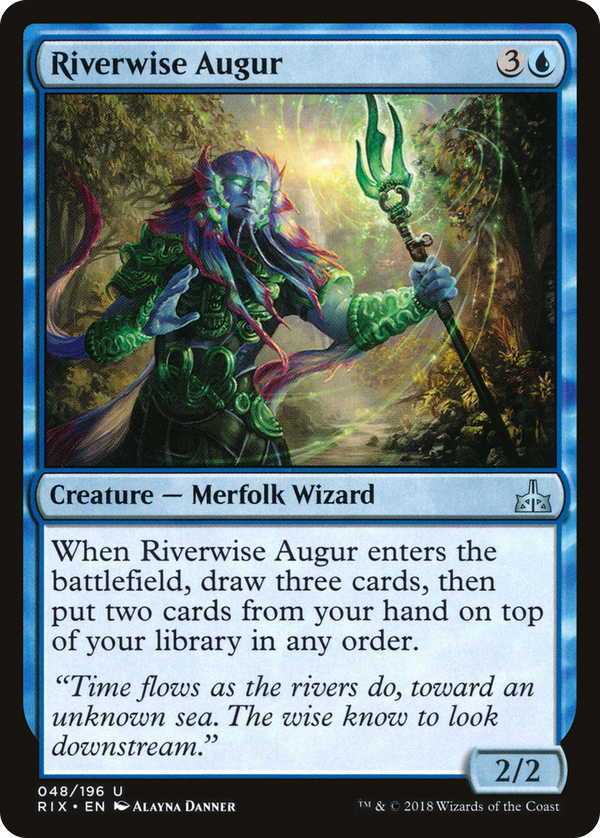
Riverwise Augur


Casting it costs a card from hand, and it hands one back: draw three, return two, and you sit at hand parity with a 2/2 on the board. The card advantage was never the draw. It is the arrangement clause. You dig three deep, keep the one you need now, and set the exact order of your next two draws: return the lands you already have, or stack a finisher behind the removal spell so they arrive in the sequence you want. That turns a Merfolk Wizard into a two-turn draw planner. The structural cousin is Brainstorm, scaled up and bolted onto a body: the same three-card look, the same put-two-back closer that lets you launder dead cards to the top and clear them later with a shuffle effect. What the creature frame buys is repeatability. A cantrip sculpts once and is gone; this ability fires again whenever the body re-enters the battlefield, so a blink or a recur-from-graveyard plan converts a single card into a recurring smoothing engine. (Bouncing it back to hand does nothing until you spend the mana to cast it again; the trigger keys off arriving, not leaving.) It rewards a deck that would rather order its library than empty its hand, and it does that on an axis most instant-speed selection of its era could only touch once. The 2/2 is incidental. The value is ongoing control over what comes off the top.