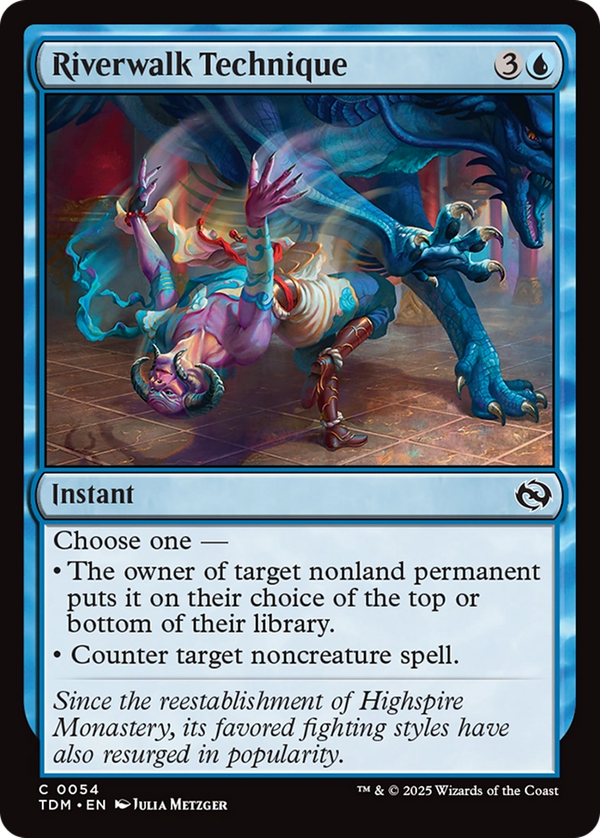
Riverwalk Technique


Two answers welded into one card, and the interesting part is how differently they fail. The tuck mode is broad but not free: it hits any nonland permanent, but it still targets, so hexproof and shroud shut it out, and the owner picks top or bottom, which means against a real threat you are spending four mana for a tuck that might reshuffle a turn of their draw or simply redraw the same threat off the top. The counter mode is the narrow one, restricted to noncreature spells, so it lives and dies on whether the table is casting artifacts, enchantments, planeswalkers, or spells worth stopping. What ties them together is that both are reactive answers priced at the same instant-speed window, so you are rarely stuck with a dead card: hold it up, read the turn, and commit to the mode the board asks for as you cast it. The catch is that at four mana neither half is efficient in isolation. A dedicated counterspell does the second job for less; a dedicated tuck spell does the first job for less. This card earns its slot only when you value the option itself, the ability to choose between the two answers each time you draw it, over the raw rate of a spell that only does one thing. It is blue interaction that punishes the reflex to spend it the moment it enters your hand.