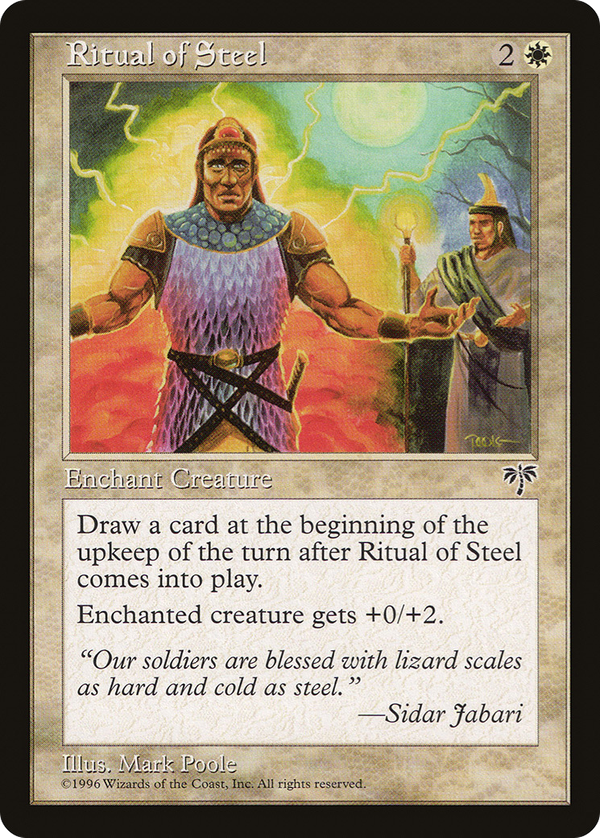
Ritual of Steel


The clearest answer to a question early Auras kept asking: why spend a whole card to make a creature slightly tougher, when a single piece of removal turns the play into a two-for-one? The fix is to hand the card back. The +0/+2 is real but secondary; the design is built around the delayed cantrip, and the timing of that draw is the whole point. Rather than replacing itself the instant it resolves, the card parks the draw on the next turn's upkeep. The value is committed but not yet collected. That delay does not protect you from the classic Aura blowout (if your opponent destroys the creature in response to the Aura spell on the stack, the Aura fizzles, never enters, and the upkeep draw never triggers, leaving you down a card and a target). What the cantrip does instead is flatten the resource math once the Aura has actually stuck: kill the now-enchanted creature and you still cost its controller the toughness, but they have already banked the replacement card, so the trade resolves to one-for-one rather than handing free tempo. It is a small, disciplined piece of design that taught players the difference between a buff that bleeds you and a buff that pays for itself, converting a historically losing card type, the pure stat-boosting Aura, into a wash on resources for everyone who let it resolve.