Rites of Refusal


Most counterspells tax the caster's mana; this one taxes your own hand first and converts the spend into someone else's tax. Power scales with how many cards you pitch, sliding from a flimsy soft counter to a wall the opponent cannot climb only when you empty your grip to fund it. That equation is the whole tension: early, when your hand is full and your board is bare, the discard barely stings and the per-card tax becomes unpayable; later, when those cards are land drops and live threats, the spell still functions but the price of making it bite rises in step. It rewards a deck stocked with cheap, redundant fodder (madness payoffs, recursion targets, ways to weaponize a stacked yard) and punishes one where every card is load-bearing. This came from an era that treated discarding as a constructive act rather than a loss, which is why the pitch clause reads less like a cost than a second mode of value: a counterspell that pays you for the privilege of casting it, provided you have a use for the cards it eats. The friction lives entirely in the read on which game you are in: the one where you can spare the cards, or the one where every card is the game.
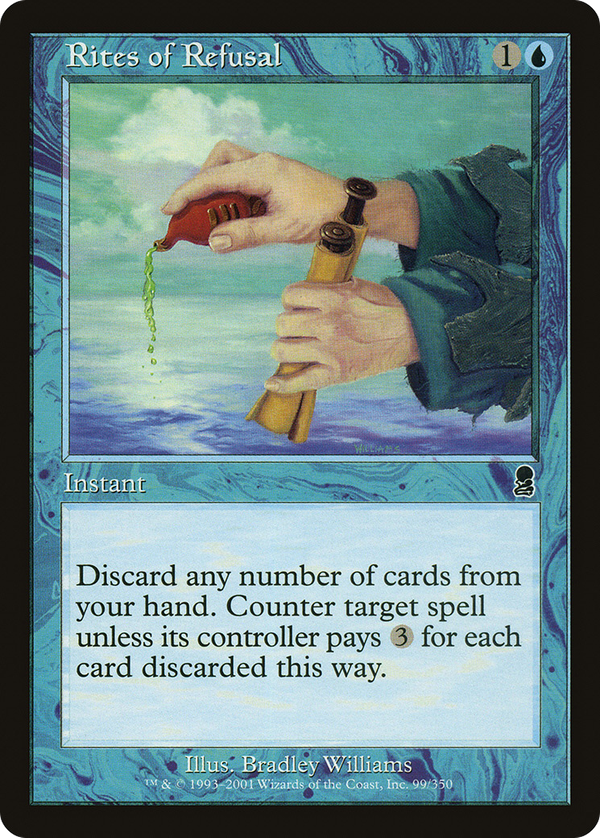
Rules text
 for each card discarded this way.