Rite of Ruin


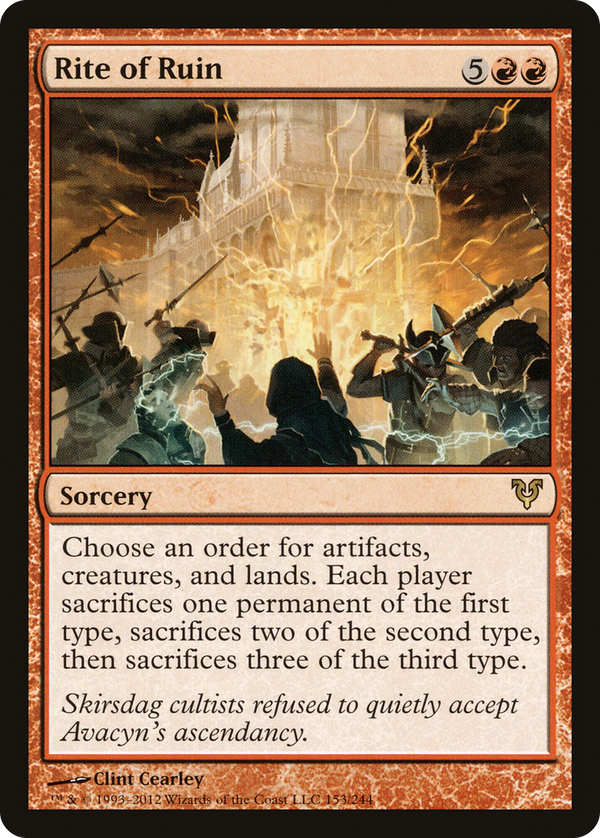
The whole card lives in one ordering decision, and the caster makes it for the entire table. You pick a single sequence for artifacts, creatures, and lands, and that order dictates that each player sacrifices one of the first type, two of the second, and three of the third. Survey every board first, then let each opponent satisfy the heavy numbers from their own permanents. That is the lever. The destruction is capped and self-selected within each category: everyone chooses which permanents to feed each count, so the symmetry is real but not equal. If you have committed almost nothing to one category, you can bury it under the heaviest number and pay in permanents you never wanted, while an opponent who built a normal board surrenders three of something that matters. The catch cuts the other way too: a player short on a type stuck with a high count loses all of it, prized pieces included, because there is no cheaper fodder to route the loss through. Token strategies weather this comfortably, their wide battlefield offering plenty of chaff to feed the threes. The seven mana and sorcery speed price the breadth, sorting it toward decks that can hold a slow play and still profit from the trade: recursion shells that buy permanents back, value piles that launder their losses through the graveyard, anything treating a reset as a tempo exchange rather than a setback. It belongs to the lineage of egalitarian mass-sacrifice effects where the shared pain is staging, and the craft is arranging the order so the heavier numbers land across the table.