Rite of Flame

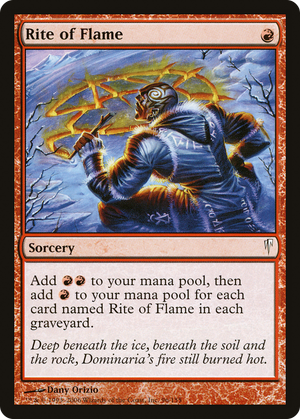
The self-referential clause is not a joke; it is the mechanism that justifies running the full playset instead of a single copy. A lone cast nets one red, the same flat return as any one-mana ritual, which makes it read like an unremarkable cousin of Pyretic Ritual or Desperate Ritual. But rituals only earn their slot in dedicated combo shells that run four, and that is precisely where the graveyard rider compounds: cast one, spend it, then the next copy you draw counts every spent copy in every graveyard and pays an extra red apiece. The second resolves for net +2, the third for net +3, and a storm or ritual-heavy chain accelerates faster than any fixed-output burst could. That is the structural difference. Standard rituals are linear: you always know what one card buys you. This one scales with how deep you already are, so its value peaks at the exact moment a combo deck wants it most, the turn the chain is already in motion. The card disadvantage built into every ritual still applies (you trade a card and a mana for net mana, so the engine only pays off when it casts something that ends the game), but the graveyard counter is the wrinkle that converts redundancy into raw explosiveness rather than diminishing returns. The flat one-mana read is the floor. The chain is the design.
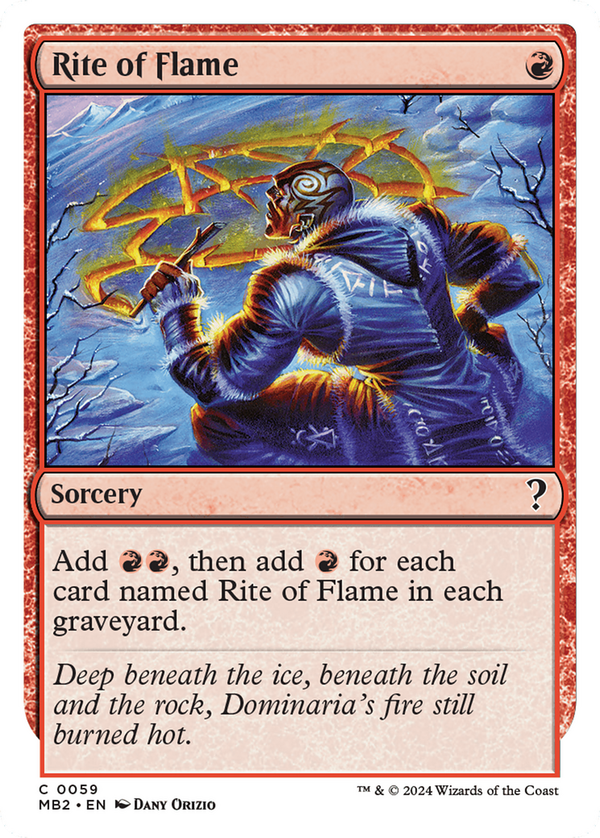
Rules text
, then add for each card named Rite of Flame in each graveyard.