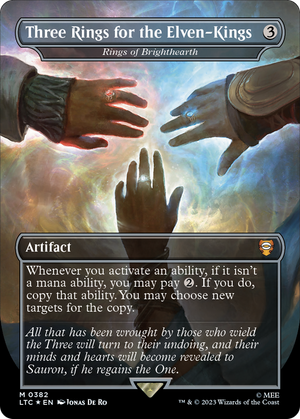
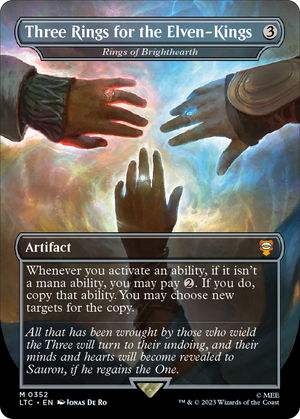
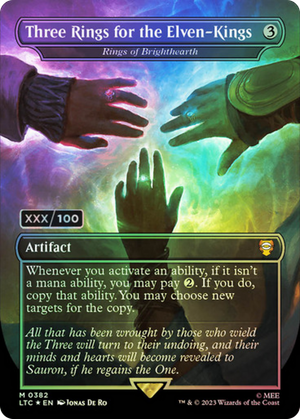
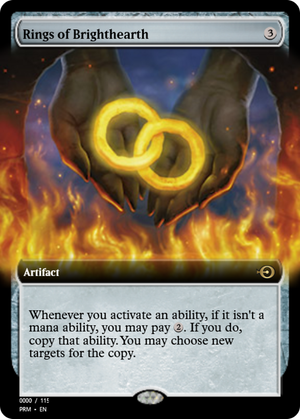
Rings of Brighthearth

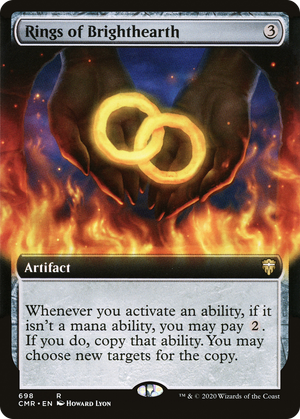
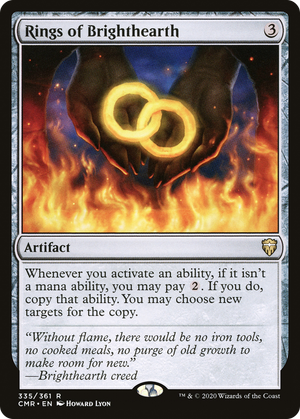
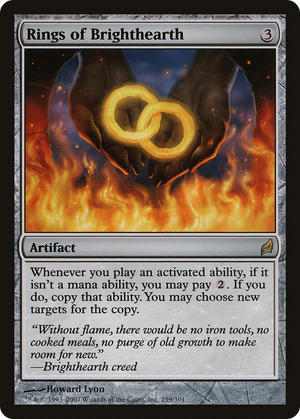
Pay two mana and any non-mana ability you activate resolves twice, with the copy free to pick its own targets. That second clause is where the depth lives: the copy can aim at a different legal target than the original, which turns a tutor activation into two different cards pulled, a removal-style activated ability into two kills, a planeswalker ultimate into two firings. The exclusion is the whole reason it belongs in engine decks rather than ramp shells: mana abilities are off the table, so this never doubles your fixing, only the loyalty abilities, sacrifice outlets, untap effects, and tap abilities that drive combo lines. The infinite with Basalt Monolith is the canonical one, copying the untap to assemble unbounded colorless mana, and across the years it has quietly slotted behind whatever activated-ability combo a format happened to surface. Illusionist's Bracers attacks the same problem from the other end, doubling a single permanent's activations rather than taxing every activation across the board, which gives builders two distinct knobs on the same effect. The design is patient by construction: it sits inert until you have abilities worth paying to repeat, and it asks you to assemble a board built to be activated before it returns anything. That conditional, build-around-me payoff is exactly why it reads as a combo enabler rather than a value rock, and why it became a fixture for players who learned to mind the gap between an ability and a spell.
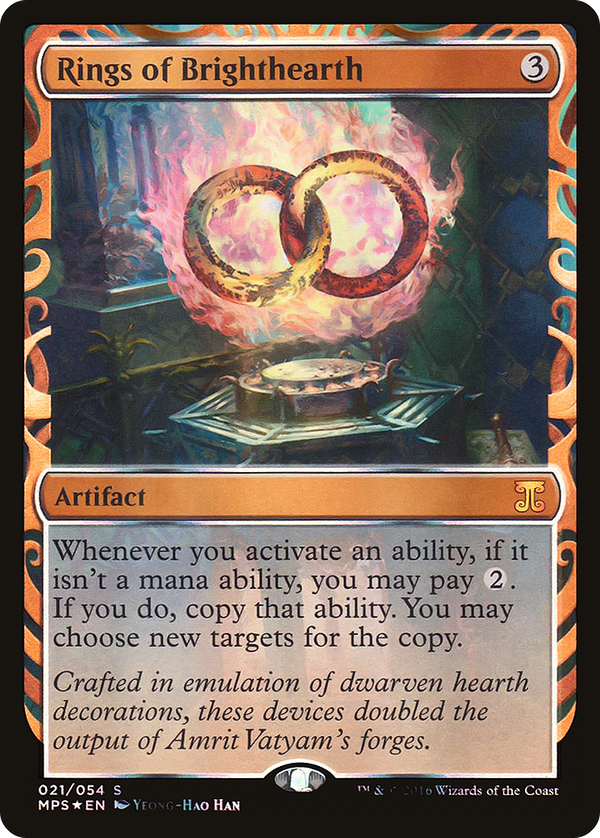
Rules text
 . If you do, copy that ability. You may choose new targets for the copy.