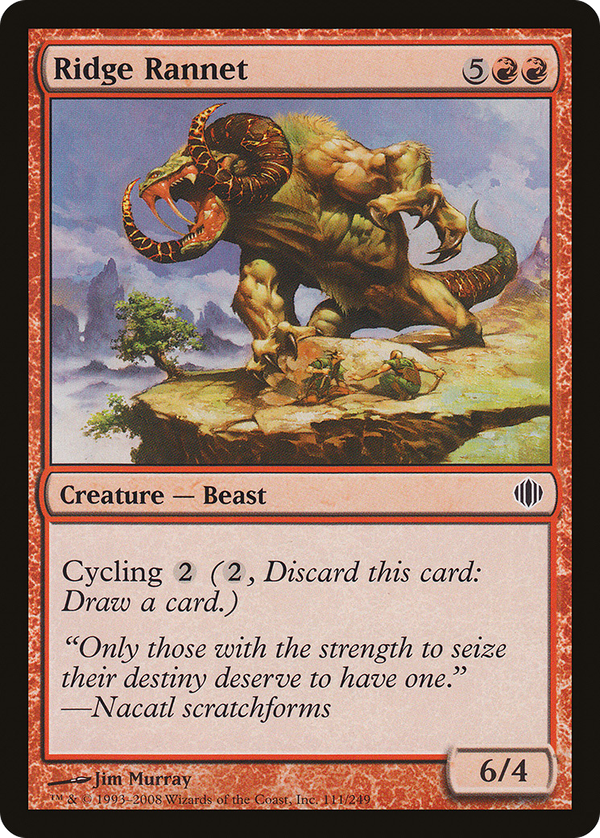
Ridge Rannet


The two-mana cycling clause is what makes a 6/4 for seven worth a slot at all. Big red bodies have always carried the same liability: drawn too early, or against a deck that will never let them connect, they sit dead in hand. Cycling writes a floor into the card itself, and the genius is that the floor and the ceiling are mutually exclusive. The body is a fast clock that demands an answer; the cycle turns a stranded fattie into a fresh card. But the choice is binary and final: you either commit seven mana to the Beast or pay two to ditch it for a draw. There is no middle ground, no later flashback, no recursion baked in. That either/or is the whole point. It means the rate on the body can run a little fat, because you are not really risking seven mana on a 6/4; you are risking nothing, since the card always converts into something the turn it shows up wrong. The decision lands the moment you draw it, and it is genuinely a decision: keep it as a threat for a board that can survive it, or feed it to the engine and move on. Cards built this way ask nothing of your deckbuilding and punish you only for holding a dead card. The Beast is replaceable; the chassis is the design.
Rules text
 (, Discard this card: Draw a card.)