Rhystic Scrying


Draw three for four mana at sorcery speed is a fine rate, the kind a card like Concentrate established as a fair baseline. The catch is the second clause, and it is the catch that defines this card entirely: after the cards hit your hand, any player can spend a trivial sum to make you discard three. The original Rhystic line ran on this symmetry, generous effects gated by a small payment any rival could choose to pay. The framing scaled exactly backward from how a deterrent should. Against a single tapped-out opponent, the downside never fires and you simply drew three for four. Add one player with two mana untapped and willing to spend it, and the spell becomes a net wash that cost you a card and a turn: draw three, then surrender three at someone else's discretion. The variance lives outside your control, keyed to other players' open mana rather than your own sequencing, and that is precisely why the "pay to punish the controller" template was never revived. The tax-versus-pay tension survived in cleaner shapes, most durably in Rhystic Study, where the payment burdens the opponent instead of the caster. This stayed a curio: a draw spell whose ceiling is excellent and whose floor is donating your fresh hand to the table.
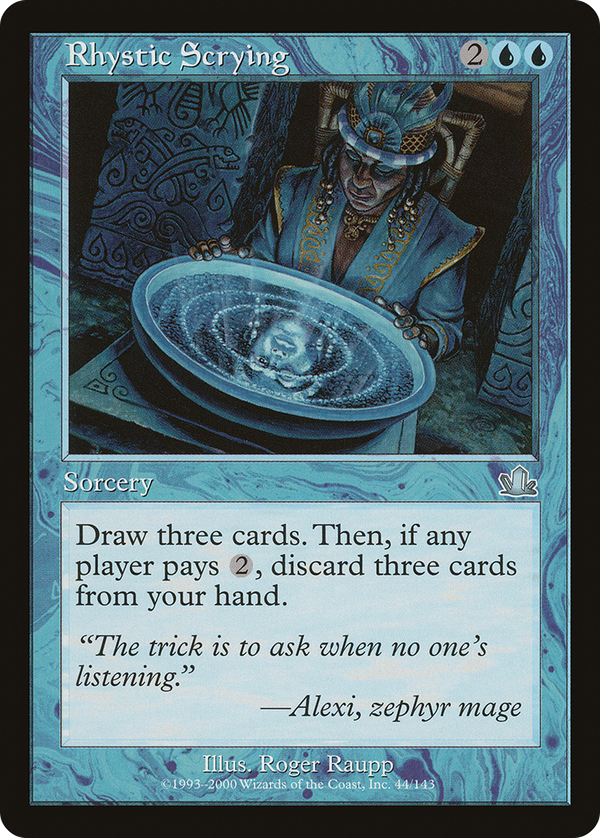
Rules text
, discard three cards.