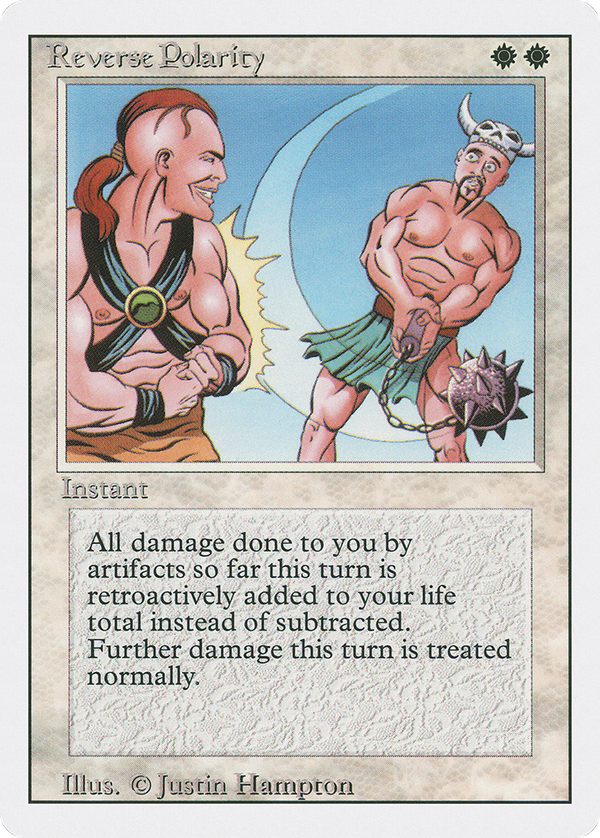
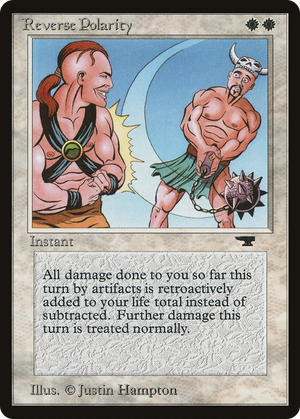
Reverse Polarity

A sideboard answer carved from a very specific moment in Magic's history: the era when Mishra's Factory, Su-Chi, Triskelion, and the Juggernaut family were the damage clocks worth building a metagame around. The doubling is the entire point of the design. A straight life-gain instant at two white mana would be a feel-bad topdeck; tying the magnitude to artifact damage already taken means the card is dead in matchups where you don't need it and overwhelming in the matchups where you do. It scales with the threat it answers, which is the cleanest way to print a hate card that doesn't warp games where the hate isn't relevant. The retroactive accounting (damage dealt to you so far this turn) is the subtle part, and it constrains the window tightly: because the tally resets each turn, the card only pays out for damage taken during the turn you cast it. The natural line is the instant-speed mid-combat stabilization, casting after blockers are declared and damage resolves to claw back twice what an attacker just landed. That window matters, because the artifact creatures of the period were built to punch through on the swing rather than ping incrementally. The card is a fossil of a format that no longer exists in any sanctioned form, but it documents how early Magic thought about hosing: not with prevention or removal, but with asymmetric arithmetic, payable only by the player being beaten down.