Retributive Wand

The pinger is a decoy. Colorless, repeatable one-damage activations have existed since the earliest days of the game, and on rate this is a slow one: pay to cast, then pay again for each shot. The real design lives in the death clause stapled to the same object, a delayed five-damage payload that fires when the artifact hits the graveyard from the battlefield. That reframes every removal spell an opponent points at it. Destroy it and they eat five to any target of your choosing; leave it alone and it grinds down their board a point at a time. The trigger has a precise gate, though: it only pays out on the trip to the graveyard, so bounce and exile answers sidestep the whole thing, walking the artifact off the board without ever setting off the five. That gives your opponent an out and gives you an incentive to control the destruction yourself. Any sacrifice outlet converts the artifact into a five-damage burn spell on demand, which is a genuinely different card than the tap-ability suggests: it wants a deck that can profitably throw it away rather than one that keeps tapping it. This is the classic problem with fragile permanents inverted: normally they invite removal, but here a graveyard death is the payoff, so the artifact protects itself by making its own destruction a liability. Anyone reading it as a slow pinger has read the top line and skipped the bottom one.
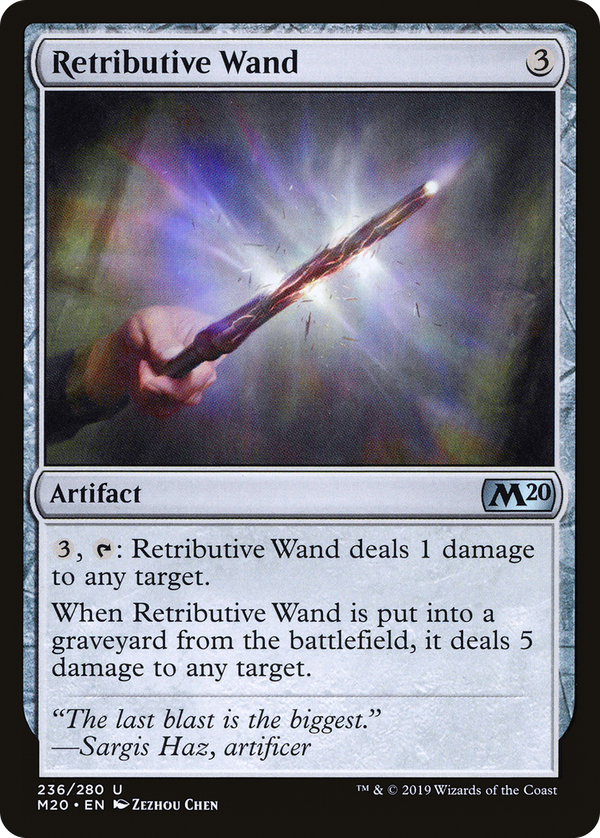
Rules text
,  : This artifact deals 1 damage to any target.
When this artifact is put into a graveyard from the battlefield, it deals 5 damage to any target.
: This artifact deals 1 damage to any target.
When this artifact is put into a graveyard from the battlefield, it deals 5 damage to any target.