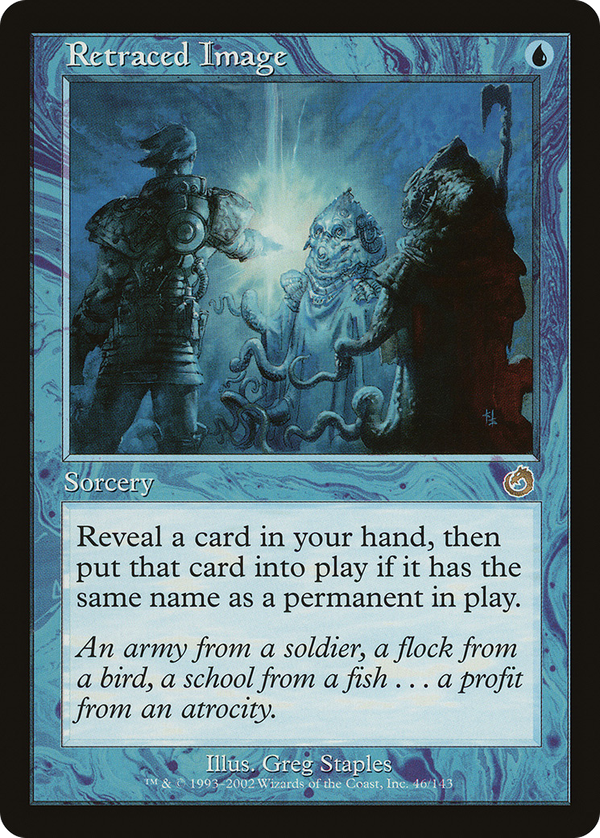
Retraced Image

The cheating it offers is real: drop a permanent straight from hand onto the battlefield for a single blue mana, no casting cost paid, no cast triggers fought over the stack. The catch is the riddle this card sets you, one of the stranger deckbuilding puzzles ever printed: the card you reveal only enters if some permanent already on the battlefield shares its name. Crucially, the check reads "a permanent," not one you control, so any matching name across the table counts. If an opponent has a basic Island in play, you can plop your Island down for a single blue mana; if anyone controls a token-maker's namesake or a copy of a famous spell-stapled-to-a-body, that opens the door too. That makes it a strangely social card, its enablement partly outsourced to the rest of the board, and it behaves like a combo piece that demands the payoff exist before the enabler does anything. The natural homes are narrow on purpose: duplicate legends that would die to the legend rule anyway, mirror-match name overlaps, or a loop that manufactures matching names on demand. Most of its life has been spent as a curiosity in the margins, a card players pick up, read twice, and set back down once the chicken-and-egg condition clicks. The design space is a closed door with the key hidden behind it, which is precisely the kind of self-referential constraint that makes a one-mana free-permanent spell safe to print at all.