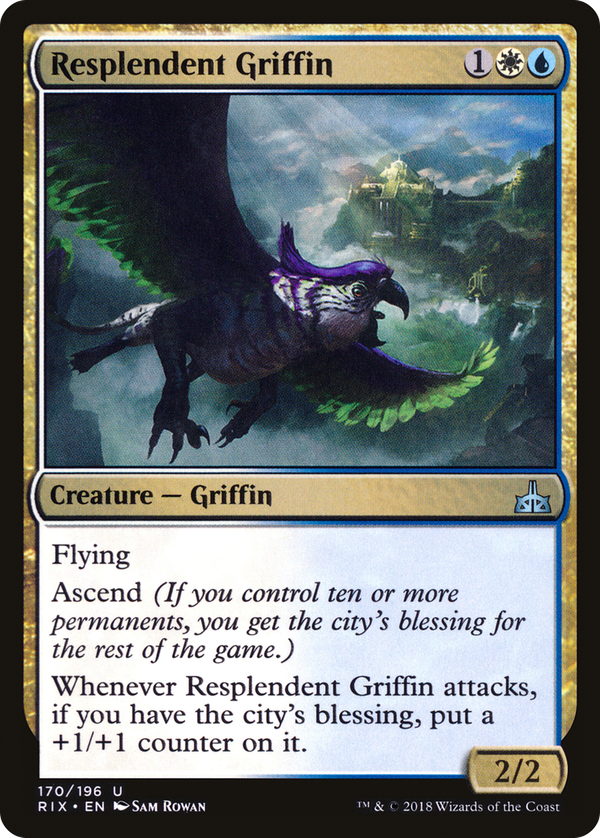
Resplendent Griffin



Ascend asks you to play a wide board and then rewards you for already having one, which is a strange ability to staple onto a flier that would rather be attacking. The tension sits right in the card: the 2/2 that stands to gain from the attack trigger is also the least likely permanent to have helped you reach ten. Once the city's blessing is online, every swing puts a permanent +1/+1 counter on the body, so the fragile flier becomes a clock that climbs each combat, blocked or not, and because the blessing sticks once earned there is no maintenance and no switching it back off. Hit the threshold once and the engine runs unattended from then on. That structure makes it a back-half creature dressed as a front-half curve filler: forgettable on the turn you cast it, dangerous after the rest of your deck has flooded the board. The design lives or dies on whether the shell around it can reach ten fast enough to flip the switch, which is precisely the deckbuilding question Ascend was built to pose. A go-wide white-blue deck that reliably gets there earns an evasive, self-sizing finisher; a deck that runs it only for the flying gets a griffin that never grows. It is the honest middle of the mechanic: the creature that forces you to decide, in deckbuilding, whether you are actually committed to reaching ten.