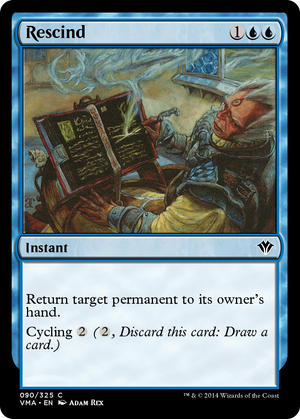
Rescind


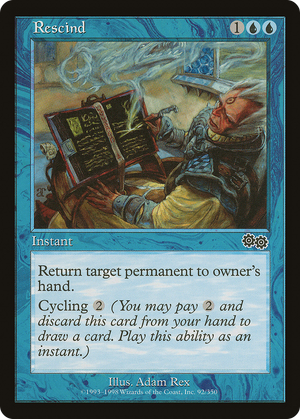
A pure bounce spell has always carried a discomfort that its rate cannot fix: against the wrong board, it sits in hand doing nothing, and the only way to avoid a dead draw is to fire it speculatively at a target you would rather not waste it on. Cycling answers that discomfort directly. The bounce itself is plain enough: any permanent returns to its owner's hand at instant speed, a tempo play that buys a turn against a blocker or breaks an enchantment lock. Stapled to two mana and a discard, though, the effect stops being situational baggage. You hold it without penalty in a matchup where bouncing nothing is good, and you hold it without penalty in a matchup where bouncing something is the whole plan, deferring the decision until you know which game you are playing. That is the value cycling was built to deliver: it flattens the variance of running narrow interaction without weakening the interaction when it lands. The effect can be a tempo answer one game and raw card velocity the next, and nothing about how you draw it forces the choice early. What makes this a useful reference point is precisely how unremarkable both halves are. An ordinary bounce married to an ordinary cycling cost shows the mechanic's logic with no rate-pushing to distract from it, the clean demonstration of why so many early designs from this era reached for the keyword.
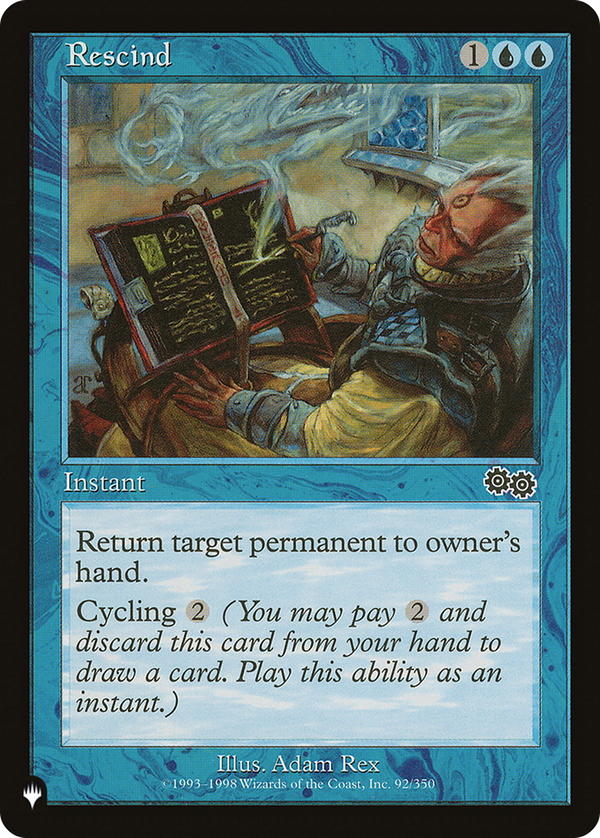
Rules text
 (, Discard this card: Draw a card.)