Repeated Reverberation


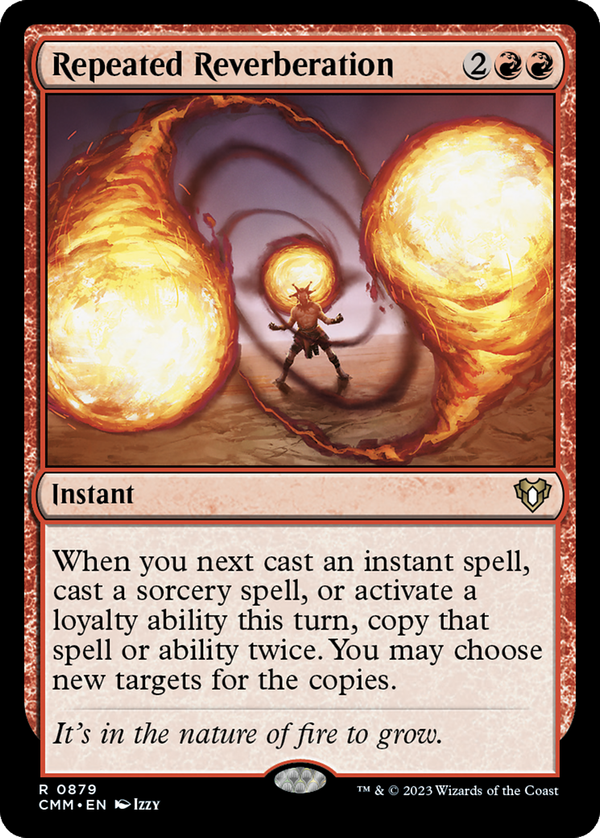
The design tension here is that a copy spell needs something worth copying, and this one solves the problem by refusing to be reactive. Where Fork and its descendants latch onto a spell already on the stack, this delays: it registers as a standing effect, then waits for your own next instant, sorcery, or loyalty activation to fire, copying that spell or ability twice for three total instances. The catch is that you spend four mana to set a trap for a future action, so the payoff card has to justify the whole two-card investment, and you have to hold up the mana or tempo to land both halves the same turn. The loyalty clause is where the design gets ambitious: triplicating an ultimate, or a plus that draws or ramps, turns a single planeswalker activation into three resolutions, the kind of blowout most copy effects were never allowed near. Making two copies rather than one is the sweetener that pushes it past the usual single-duplicate rate, and the freedom to pick new targets means the second and third resolutions can spread across the board rather than piling onto one victim. It is a build-around by nature: the card does nothing until you supply the spell or ability that earns it, and the reward scales entirely with how greedy that follow-up is.