Remove Enchantments

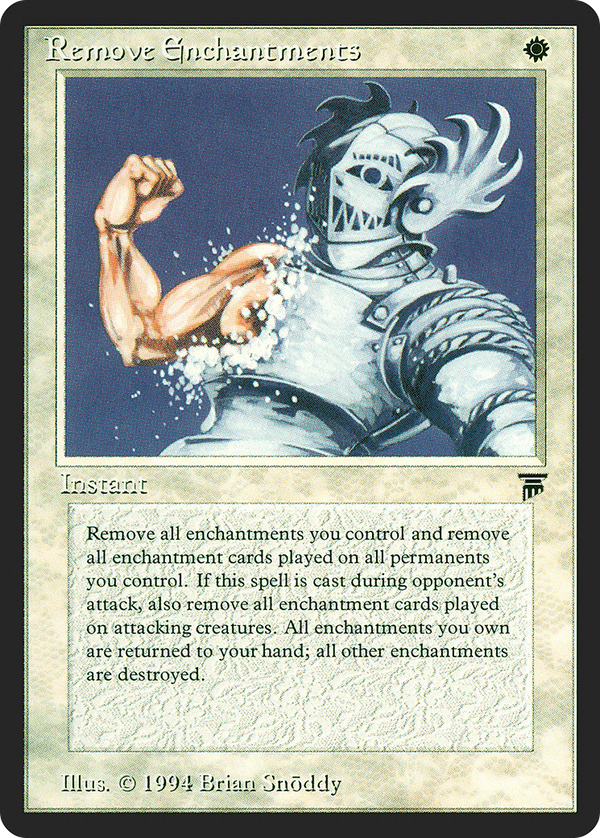
An asymmetric reset built around the word "own." The design lets a player solve a board tangled with hostile Auras by reclaiming everything that is rightfully theirs and incinerating everything that is not: a Pacifism you own (still stuck on your best creature) returns to your hand, while the Auras an opponent has stranded on your permanents are destroyed. The split runs strictly along ownership. Enchantments you both own and control come home; enchantments you control but do not own are what the spell destroys, which is precisely the foreign Aura cluttering your side. The combat-step clause is the strangest piece of the design. Auras you own attached to attacking creatures your opponents control come back to you, encoding an unwind of stolen-creature plays in an era when control-magic effects routinely shipped your creatures across the table with your enchantments still riding along. That clause dates the card as much as the mana value does; it answers a board state the early game spent years building vocabulary around. The cost completes the trick. One white mana for a sweeper-shaped effect works only because the sweep is gated by ownership: the destruction never reaches an opponent's freestanding enchantments, only the foreign Auras on your stuff and any other Auras on your opponents' attacking creatures. Read as a rules artifact, it stands among the clearest early uses of ownership rather than control as a balance lever, and the narrowness of what it can actually touch is exactly what licenses the price.