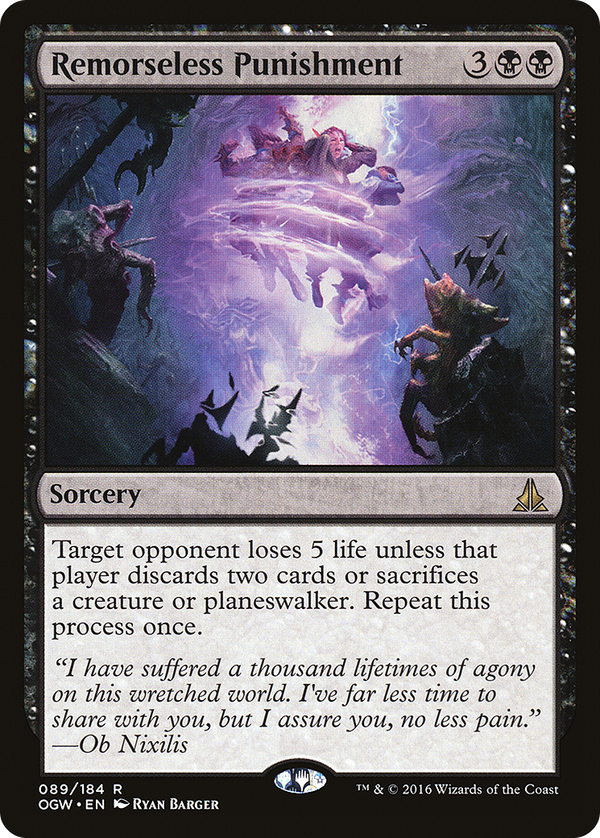
Remorseless Punishment


Most punisher cards offer a single fork: the opponent picks one of two outcomes, and you live with whichever they hand you. This one runs the loop twice, and the doubling is where the math turns ugly for the defender. Five life or two cards or a creature-or-planeswalker, then the same fork again, each leg resolved independently. A player can pay ten life. A player can pitch four cards. A player can lose two bodies. Most often they mix the answers, which is the point: every combination they assemble to soften the blow is a resource they no longer have. The design problem with punisher effects is that they hand agency to the person being punished, and a competent opponent always chooses the cheapest line. The fix here is breadth. By stacking life, hand, and board into one repeated choice, it removes the clean out entirely; there is only a least-bad bleed. That makes it a closer rather than a tempo play. It rewards a board state where every option already hurts: low life makes the ten-life clause lethal, an empty hand makes the discard impossible, a thin board makes the sacrifice ruinous. The card does its best work when the opponent has already been squeezed on multiple axes, and it punishes the recovery they were counting on rather than the position they currently hold.