Rejuvenate


A bare lifegain sorcery at this cost has never been worth a card, and the entire point of this one is that it almost never reads as a lifegain spell at all. Cycling for  converts a dead late-game topdeck into a replacement card, so the deck pays a small premium to register a flexible piece of paper: a cantrip most of the time, a stabilizing six-point gain only on the rare turn you actually need to climb out of burn range. That is the structural maneuver the whole early cycling cycle was built around: pricing a marginal effect as something you can spend away when it is irrelevant, which lets a designer push the effect itself harder without flooding hands with situational dead weight. The number six is chosen with that escape valve in mind, generous precisely because the floor of the card is "draw something else." It works as a teaching example of how cycling rewrites the value of a spell no one would otherwise run: the effect does not have to be efficient, it only has to be occasionally decisive, because being wrong about it costs almost nothing.
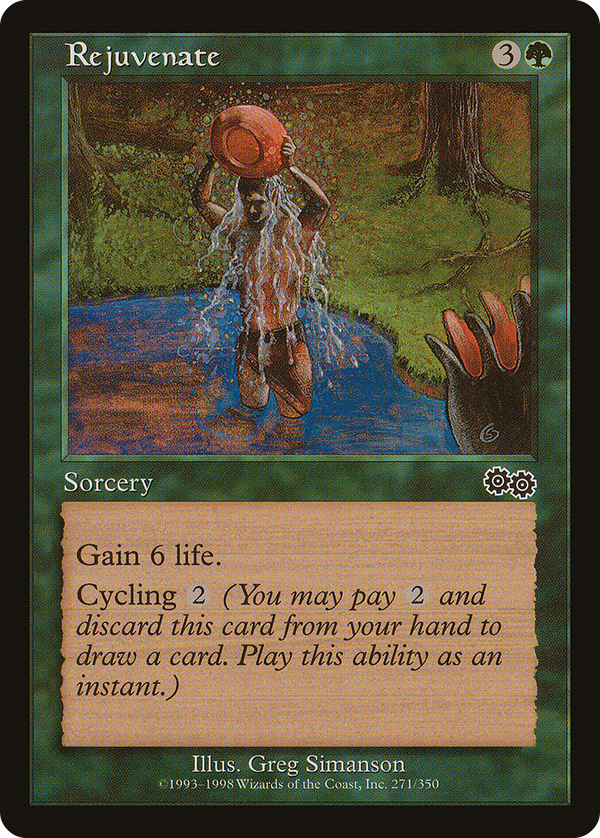
Rules text
(, Discard this card: Draw a card.)