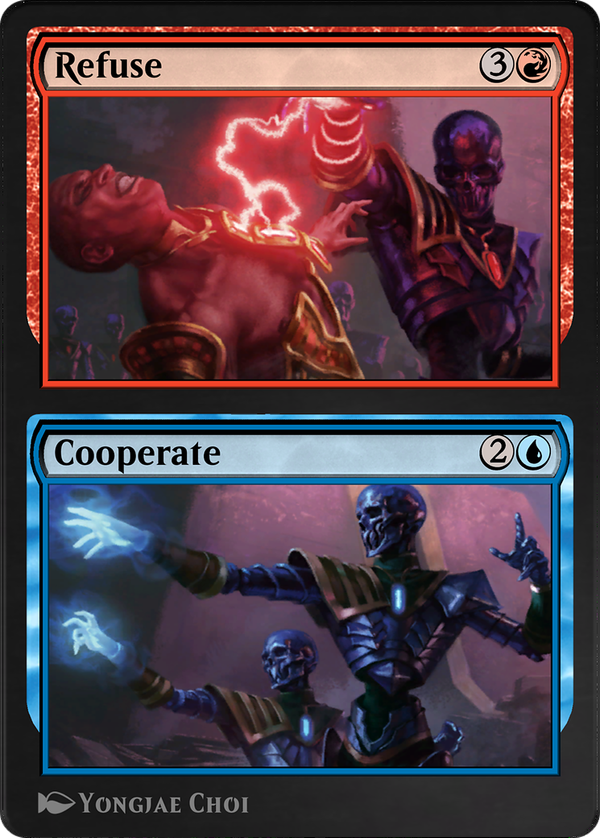
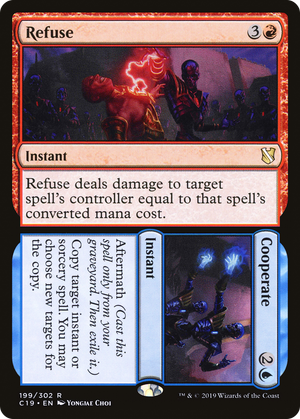
Refuse // Cooperate




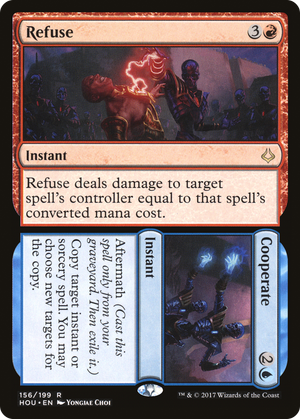
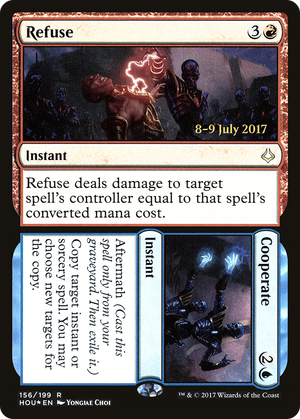
Aftermath is doing more here than splitting a card into two spells: it forces a sequence where the second half cannot exist until the first is spent. Refuse has to be cast (or otherwise sent to the graveyard) before Cooperate ever becomes castable, so the front half is quite literally the fuel for the back. That structural gate is the point. Refuse itself is a punisher that declines to interfere: it lets the target spell resolve and deals damage to that spell's controller equal to its mana value, so the toll scales with the opponent's ambition rather than shutting anything down. The bigger the play, the harder the hit, which makes it a tax on greed instead of an answer. Cooperate is a fork by any other name: copy any instant or sorcery already on the stack, yours or theirs, and repoint the copy wherever it does the most work. It is purely additive, dead on an empty stack and lethal on a full one. What ties the two modes into a single design is the arming step. A card that would otherwise idle in hand becomes two distinct interactions spread across two visits to the stack, and burying the damage half is precisely what loads the copy half. Both modes reward a player treating the stack as live terrain: one bills the controller by the weight of what it lets through, the other piggybacks on a resolution already in motion.