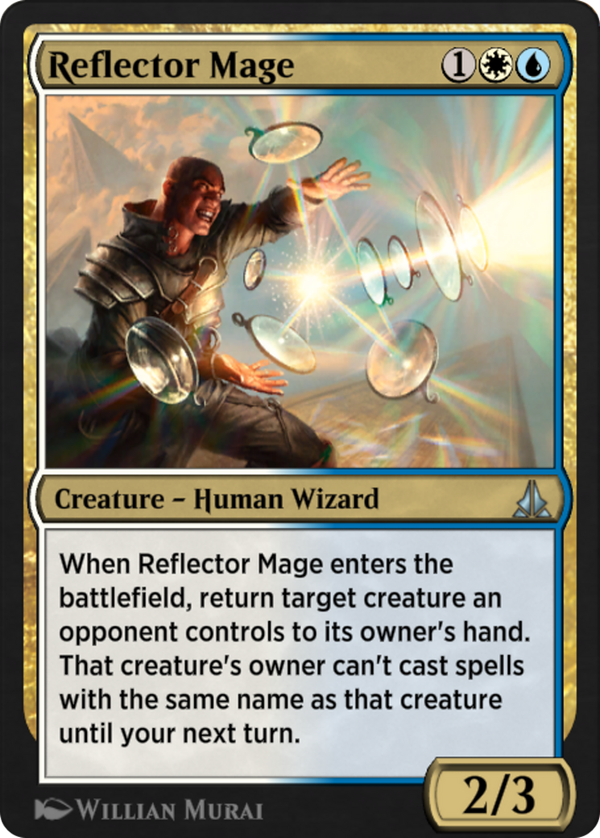
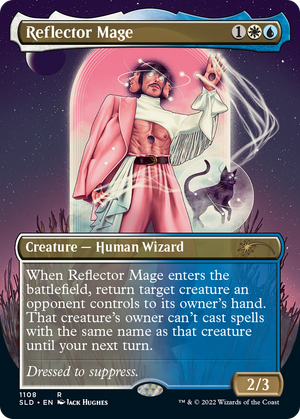
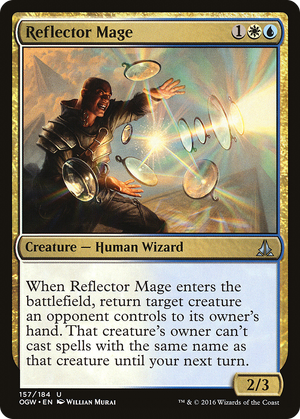
Reflector Mage



Bounce had always been the gentle answer: you delay a creature, the opponent recasts it, you've bought a turn and a card. The clause stapled to the back end is what turned that tempo trade into a genuine swing. Locking the bounced creature's owner out of recasting it until your next turn means the opponent doesn't just replay the threat a turn slow; they have to spend that mana on something else entirely, or sit on it. The recast tax is the real card, and the body that delivers it (a 2/3 that stays back as a blocker the turn after it lands) makes the whole package double as a wall. The name-based restriction is sharper than it looks, too: it reads as a small inconvenience but is precise enough to gum up decks leaning on a key four-drop or a singleton bomb, since the one spell they most want back is exactly the one they can't replay. It hit hard enough that competitive Standard banned it, a rare fate for a three-mana creature whose stat line invites no fear. The interaction that earned the ban was relentless: in a deck full of cheap creatures, every copy resets the opponent's best body while leaving behind a blocker, and chaining them turns tempo into a soft lock. The design lesson outlasted the ban: a bounce spell with a memory attached is a different card than a bounce spell without one.