Reflecting Mirror

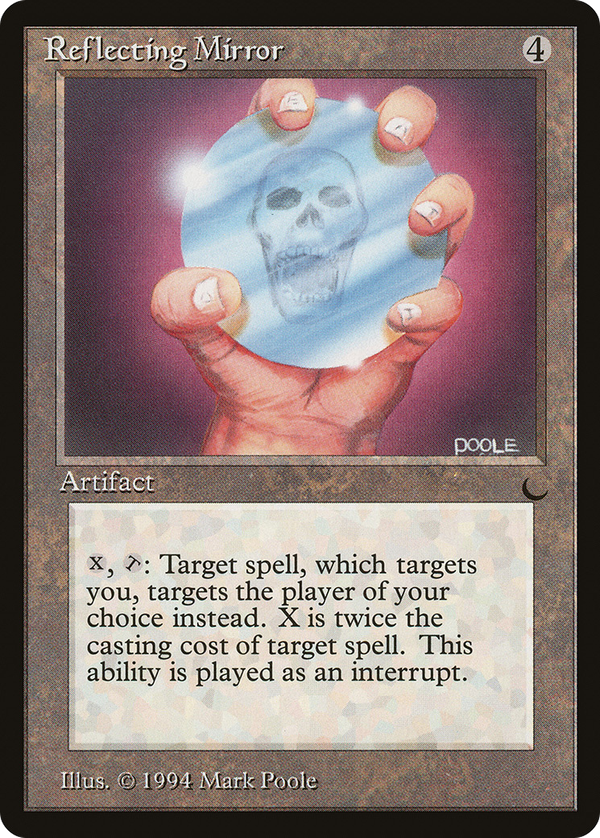
A pure piece of redirection technology from a period when Wizards was still mapping the edges of what "target" could mean on the stack. The clause is narrow on purpose: it only touches a spell with a single target, only when that target is you, and the redirect can only land on another player. That tight aperture turns the artifact into a defensive parry against the era's single-target burn and discard, bouncing a Lightning Bolt or a forced sacrifice back at the caster or a third party rather than absorbing it. The pricing is where the design philosophy shows: X equals twice the mana value of the spell you are deflecting, so the cheaper and nastier the spell aimed at your face, the cheaper it is to turn around, while a big finisher demands a real investment to reflect. It reads as an early answer to a problem the rules had not fully formalized yet, redirection predating the cleaner templating that later cards like Deflection would inherit. The constraint to player targets, rather than any target, keeps it from rewriting combat or sniping creatures; this is a political and defensive instrument, a way to make an opponent eat their own removal, not a Swiss-army redirect. Built in an age that prized intricate, conditional artifacts over efficient ones, it captures how cautiously the game once handed players control over someone else's spell.
Rules text
 ,
,  : Change the target of target spell with a single target if that target is you. The new target must be a player. X is twice the mana value of that spell.