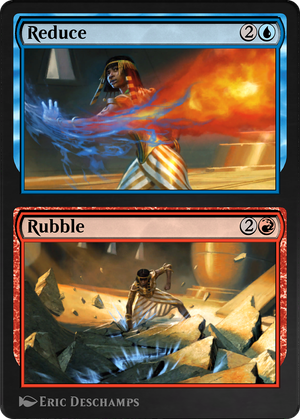
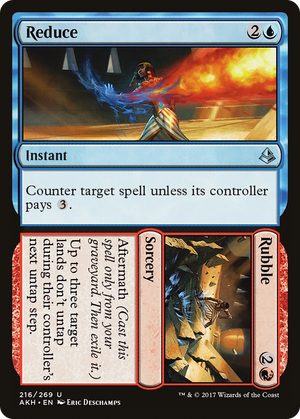
Reduce // Rubble



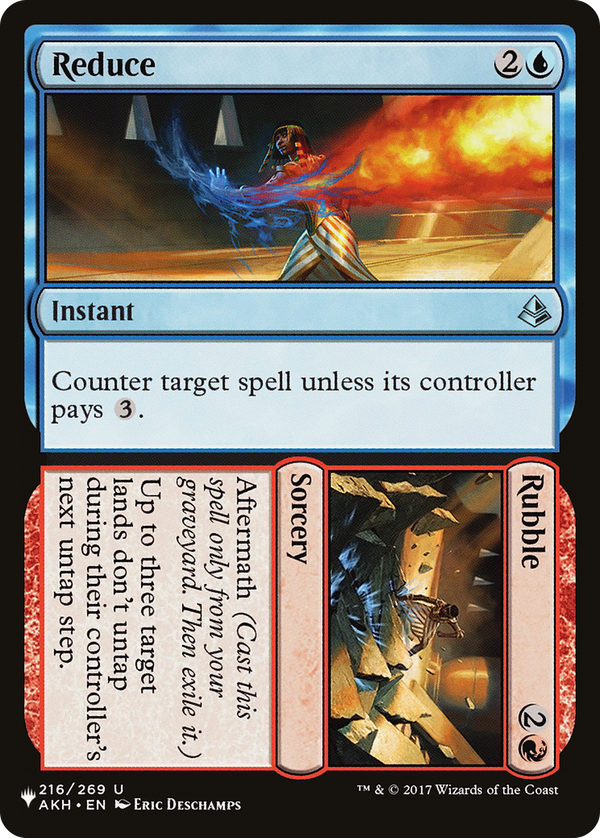
Aftermath asked the simplest question about a split card: what if both halves are spells, spent at different points in the game? The answer here is a tax counter and a land-locking tail, two effects that share no battlefield logic but split one card's value across the graveyard. The front half is a soft counter, only as strong as the opponent's open mana stays tight. The back half is a tempo effect recovered from the bin after the counter has already been spent. The structural trick is that the card never goes fully dead: once cast, Reduce heads to the graveyard, and the graveyard is exactly where the land-locking half waits. That graveyard-only clause does the work flashback's exile does elsewhere, converting a spent card into a second, fixed play rather than a recast of the first. The two halves live on opposite sides of the timing chart, and that is where the design's texture sits. The counter is an instant, held up on a rival's turn or fired on your own; the land-lock is a sorcery, castable only when you hold priority in your main phase with the stack empty. So the sequence is asymmetric: you can counter a spell at any point and, later, once you reach an empty main phase with the mana, follow up with Rubble. What the structure forbids is the reverse. You can never lead with the sorcery and still hold the counter open. Reactive interaction and proactive disruption are separated not by turn but by the shape of when each half is allowed to happen.
Rules text
 .
//
Aftermath (Cast this spell only from your graveyard. Then exile it.)
Up to three target lands don't untap during their controller's next untap step.
.
//
Aftermath (Cast this spell only from your graveyard. Then exile it.)
Up to three target lands don't untap during their controller's next untap step.