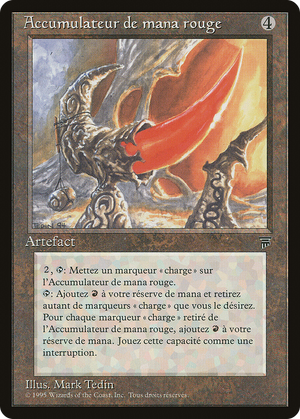
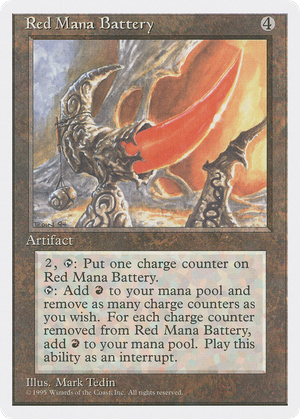
Red Mana Battery

A fossil of an earlier design philosophy: the idea that ramp should be slow, painful, and pre-committed. You can tap it bare for a single red, like any mundane mana rock, but that is the trap; doing so makes it four mana for an artifact that produces less than its cost suggests. The card only justifies itself by paying  per turn to bank a charge counter, spending real mana now to bury red in a reservoir for later. The math is brutal by modern standards. Two mana stored as two future points of red is a losing trade in isolation, and the battery asks you to keep feeding it instead of doing anything productive, turn after turn, until the reservoir is deep enough to matter. What it offers in return is exactly that hidden mana: the ability to dump six or eight red at once into an X-spell or a chain of burn, an explosion your opponent never saw coming. That is the design lineage worth tracing. The battery cycle was an early, clumsy attempt to let a deck save resources across turns, before cheap one-shot accelerants like Lotus Petal delivered the same burst faster without the upfront tax. The whole cycle was quietly retired once Wizards learned to price acceleration properly; a card that demands you mortgage your early game for one explosive late turn stopped being a bargain worth making.
Rules text
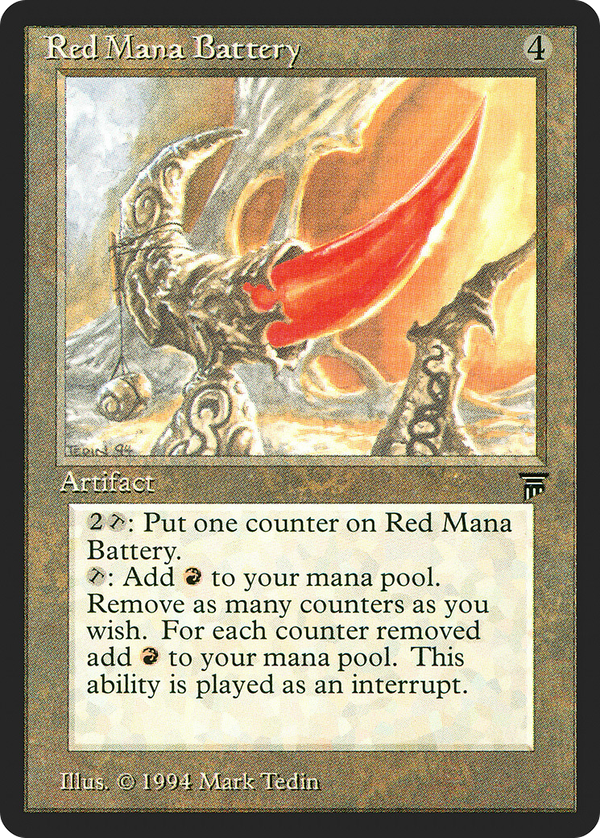
,  : Put a charge counter on this artifact.
, Remove any number of charge counters from this artifact: Add
: Put a charge counter on this artifact.
, Remove any number of charge counters from this artifact: Add  , then add an additional for each charge counter removed this way.