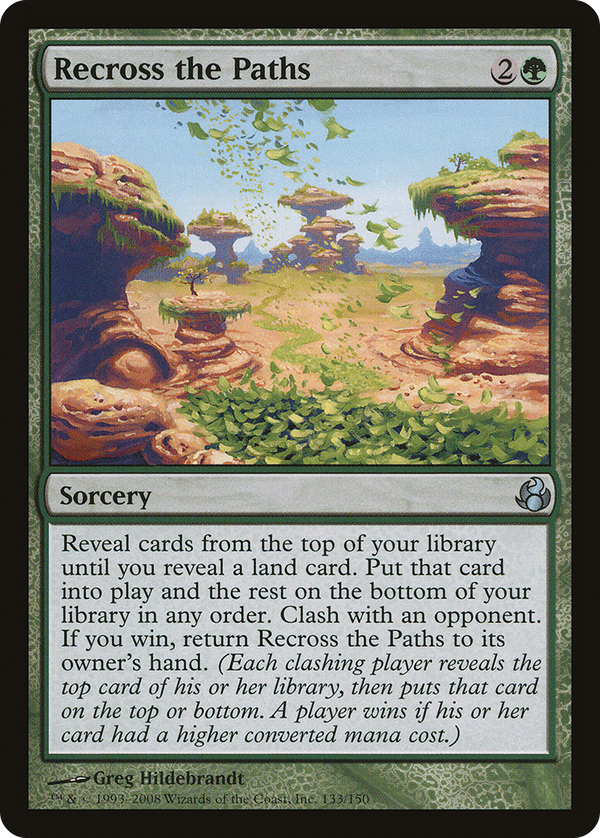
Recross the Paths


Cheating a land into play is the visible payoff, but the deck-stacking clause is where this design earns its strange reputation. Build a library with exactly zero lands and the first line of text changes character completely: with no land to find, you reveal your entire library, then bottom all of it in any order you choose. One resolution, and your draws are scripted from there down. The clash, which on its face looks like the card's central mechanic, becomes irrelevant in that build: winning it would only return the spell to your hand, but you have already arranged everything on a single cast, so there is nothing left to do. That inversion is the whole interest here. As a fair green sorcery, the bottoming clause is a minor cleanup and the clash a mana-value comparison that occasionally recurs the card; in a landless combo shell, the bottoming clause is a deterministic full-library stack and the clash is dead text you happily ignore. Few cards hinge their actual function this completely on a deckbuilding decision the card never mentions, and the version players care about is the one where most of the printed mechanics fall away. The ambition reads as much stranger now than the modest land-into-play line suggests: green handing you authorship over the order of your entire deck, packaged as a ramp spell with a clash rider.