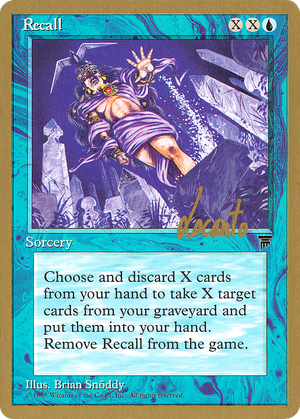
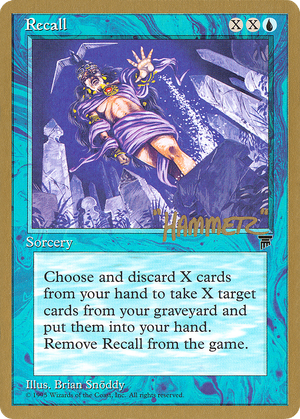
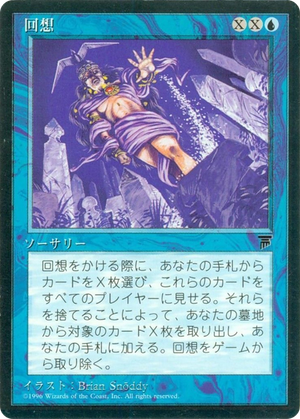
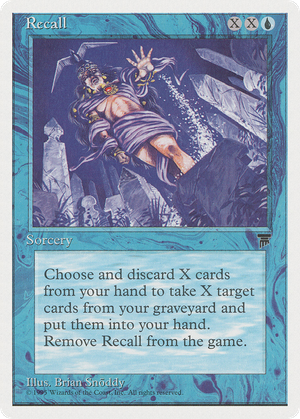
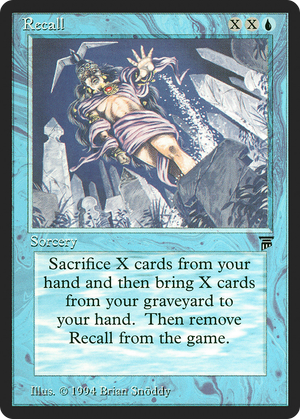
Recall


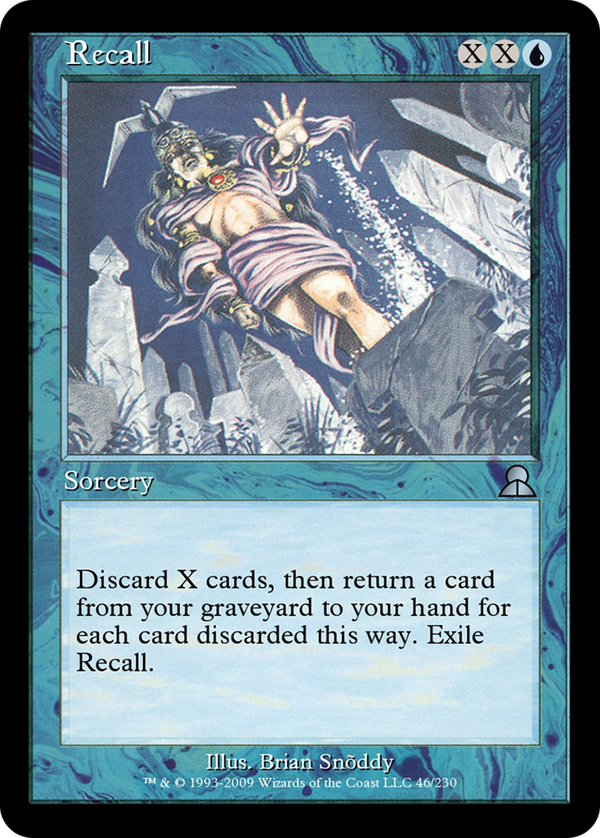
An early attempt at scaling graveyard recursion through a variable cost, and one that quietly encodes a design tension blue has been negotiating ever since: how much should the color pay to convert its graveyard into a hand? What you get here is a discard-then-return loop where the cost is paid twice (once in mana, once in cards from hand) and the payoff scales linearly with both. The clever part is the routing: the discard is not pure cost but a filter, letting you cycle the dead cards in hand into the live ones sitting in your graveyard. You feed in what you do not want and pull back what you do, which rewards a player who has already stocked the graveyard with answers worth more than the chaff currently clogging the grip. That self-sorting quality is the design idea: a Regrowth that scales, gated by a hand tax so the player who wants more cards back has to part with more cards first. The shape predates most modern recursion templates, and its descendants tend to split the difference, fixing costs, narrowing targets, or moving graveyard-fill into a separate step. The exile-on-resolution clause keeps the X-cost scaling from running away; without it, the math would have produced a permanent engine rather than the one-shot it is.