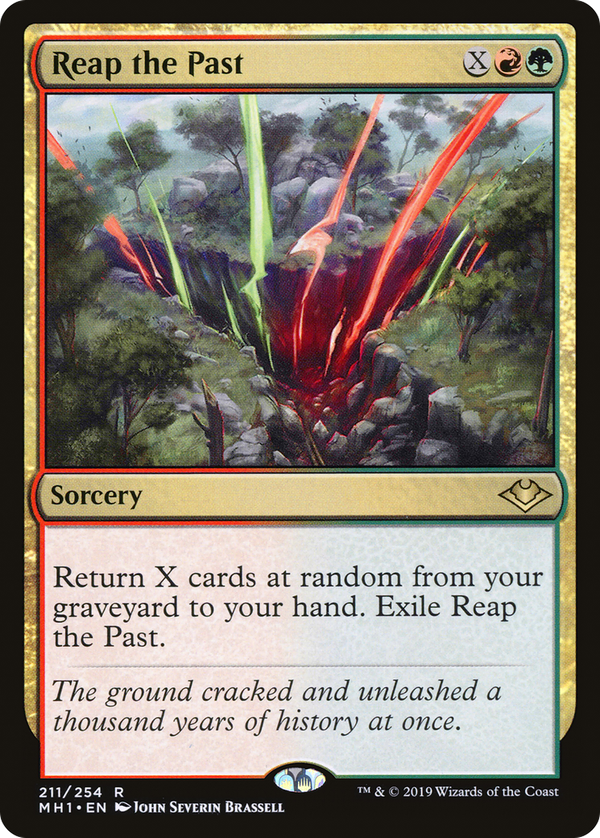
Reap the Past



The randomness is the whole trade. Bulk graveyard recursion usually comes at a premium or with a selection cost: you pick the cards you want, and the spell charges you for the privilege of choosing. This one strips choosing out of the equation and prices the effect accordingly, letting you scale X as high as your mana allows in exchange for surrendering control over which cards come back. In a deck where the graveyard is stocked with roughly interchangeable payoffs (a pile of cheap spells, a mass of small creatures, redundant threats), the randomness barely matters, because any five cards off the top of the pile refuel the hand just fine. The design breaks the moment you want a specific card back, and that is deliberate: the effect is built for decks that measure their graveyard by volume rather than by any single key piece. The self-exile clause is the other half of the bargain, keeping the spell from becoming its own recursive loop and capping it at a single large reload rather than a repeatable engine. It is a mass-return effect for the player willing to gamble on quantity, sized by mana, paid for in precision.