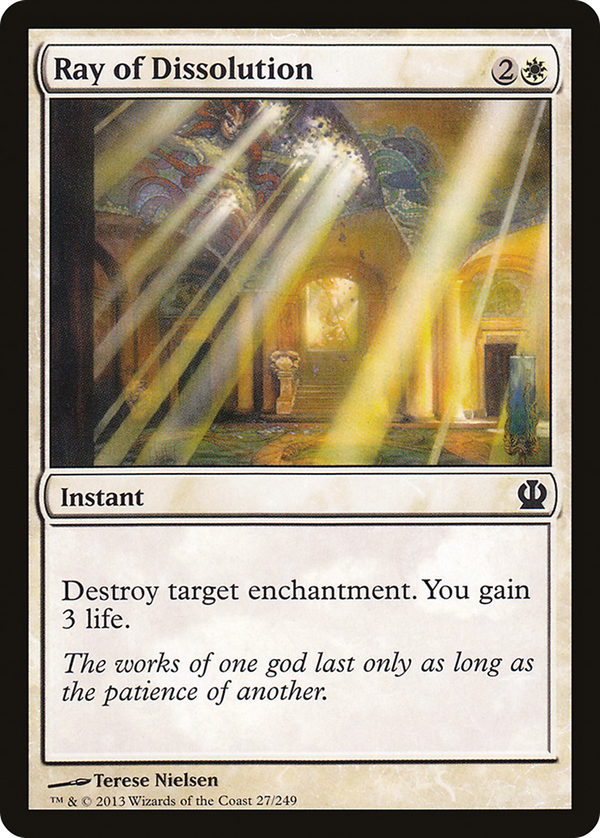
Ray of Dissolution


Disenchant has been the white baseline for stripping enchantments since the earliest days: two mana, instant speed, gone. This trades up to three for a piece of incidental lifegain, and the two changes pull in opposite directions. The extra mana and the narrowed target (enchantments only, never the artifacts a broader answer can also catch) are the cost; the three life is the reward for hitting something that matters. Note that this is gained life, not life paid: there is no downside clause here, just upside stapled to an answer that usually trades one-for-one. Gaining life is not gaining cards, so this does not generate advantage in the abstract. What it does is change the spell's posture against decks that win through enchantments. Against a curse bleeding you out, an Aura on the wrong creature, or an anthem holding up a wide board, you remove the engine and claw back some of the life it already cost you. That nudge tilts the holding-versus-firing decision: a clean Disenchant wants to trade the instant a target appears, while a small life cushion makes patience cheaper. Where enchantments are scarce, the higher cost and the lifegain are both dead weight; where they matter, this is the disenchant that rewards you for waiting. White has long stapled small life totals onto its utility spells, and this applies that habit to the genre's most fundamental answer: the same removal, with a reason to enjoy casting it.