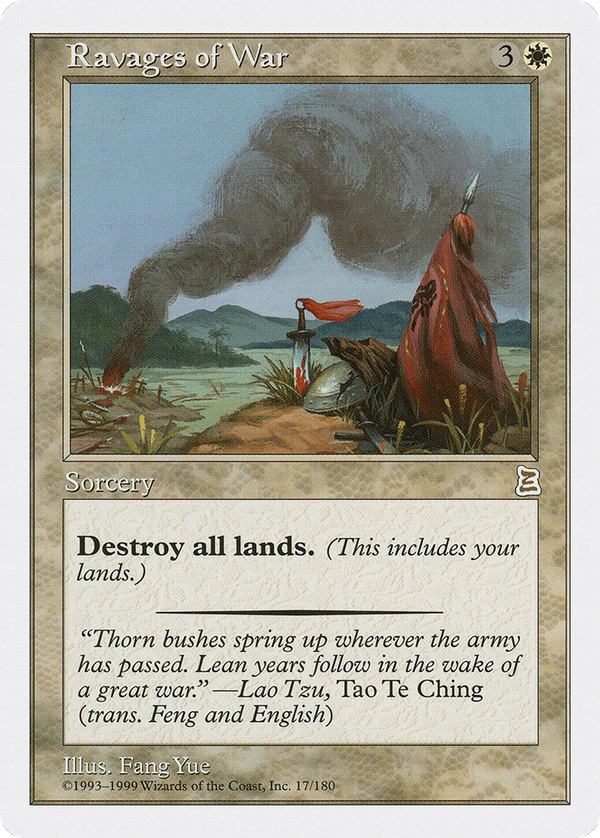
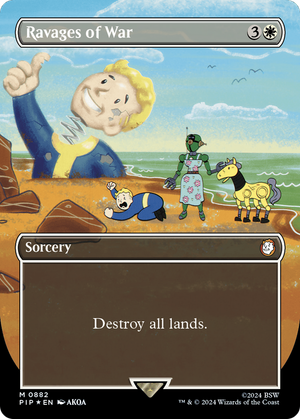
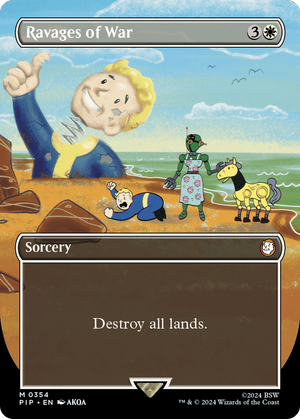
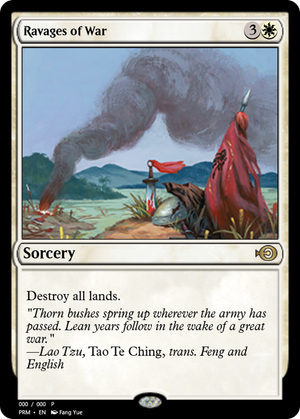
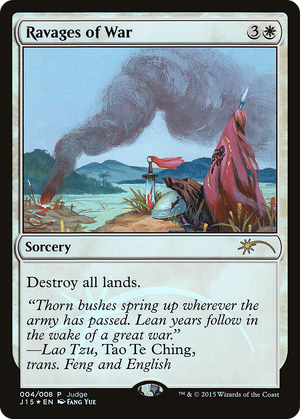
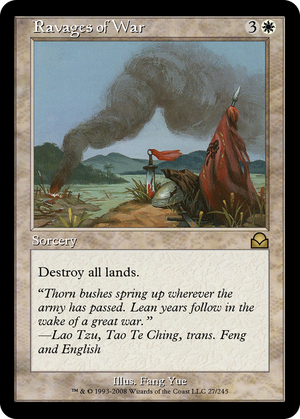
Ravages of War


Armageddon in white border. The effect is identical to its black-bordered ancestor: a four-mana sorcery that strips every land off the battlefield, yours included, and resets the game to its first turn of mana development. What it represents is the simplest, most brutal expression of white's claim to land destruction, a color that otherwise has almost no presence in the mass-Stone-Rain space. The strategic logic is older than the card's first printing: cast it from ahead. You want a board that wins through the rubble (a creature already in play, an artifact mana source untouched by the symmetry, a planeswalker ticking up) so that the symmetry is only symmetric on paper. Pay four, blow up the world, and let your existing advantage do the rest while the opponent rebuilds from zero. That asymmetry of timing, not the spell's text, is what makes it a finisher rather than a stalemate-maker, and it is why this style of effect has spent its entire history at the center of the format-warping debate over whether resource denial is fun to play against or merely effective.