Raucous Carnival
Dual lands have always paid for their color-fixing with a tempo cost, and the design lever that decides how expensive that cost feels is the condition that lets the land enter untapped. Here the toll comes off only when someone sits at 13 life or less, a deliberately aggressive condition that favors the deck already spending life to push damage rather than the deck sitting behind removal. That inverts the usual logic of conditional taplands, which tend to reward the controlling seat that can afford to enter tapped early and cash the fixing later. This one wants a life total already sliding down, either yours from painlands and fetches or an opponent's from a fast clock, and it does not care whose it is: the clause checks any player. In openings where nobody is under pressure it plays as a plain tapland, which is the price you accept for a card that produces two colors and turns on for free once the board state gets bloody. The Boros pairing is the tell for the archetype it serves; red-white aggro is exactly the deck comfortable trading its own life for speed, and the one most likely to see 13 arrive by turn three or four.
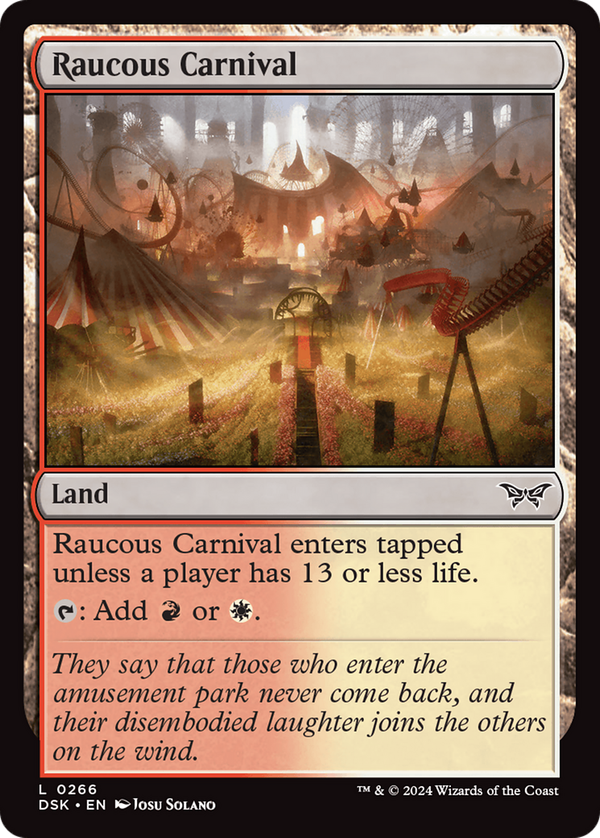
Rules text
 : Add
: Add  or
or  .
.