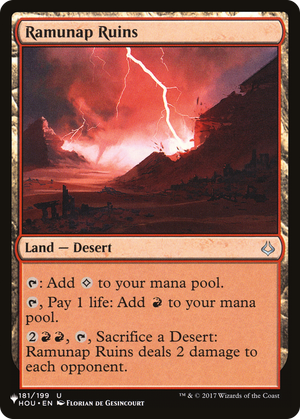
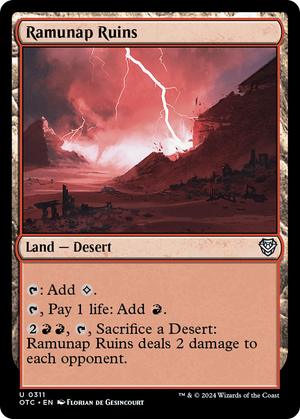
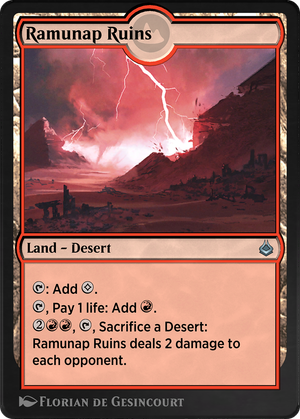
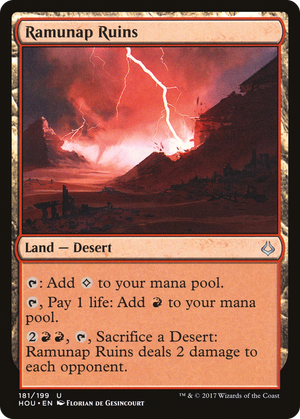
Ramunap Ruins
Fast red decks have always run out of gas at the same place: the opponent stabilizes on four or five life after a round of blocking and trading, and the aggressor has an empty hand. This land answers exactly that gap without asking the deck to bend its curve or its manabase around it. A colorless source, a painful red one that costs a life those decks were racing past anyway, and, once the board stalls, an alternate route to the last few points: the front of the card is deliberately unremarkable while a win condition accumulates across the lands themselves, one Desert at a time. A land that has done its manabase job stops being spent and becomes a finisher stored where no removal spell reaches. That inevitability is what got it banned in Standard, where a hand full of Deserts became a kill no lifegain could outrace. The math compounds faster than the individual numbers suggest, because every Desert you draw and land is another two points the defender has to survive on top of whatever burn is already in hand. The caution shows up in how repeatable reach off a land has been priced ever since: direct damage sourced from the manabase is a resource the game treats as far more dangerous than the isolated figures look, precisely because it costs the deck running it almost nothing.
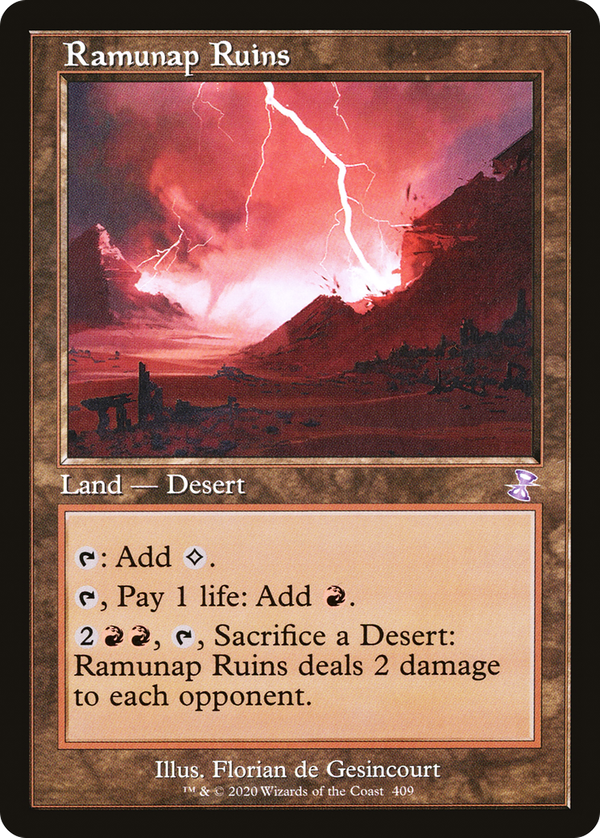
Rules text
 : Add
: Add  .
, Pay 1 life: Add
.
, Pay 1 life: Add  .
.
 , , Sacrifice a Desert: This land deals 2 damage to each opponent.