Rakdos Cluestone

The whole guild-Cluestone cycle solved a recurring problem for two-color decks that ran out of gas: a mana rock that wasn't dead weight in the late game. Fixing for the front half, a card for the back half, with the sacrifice clause priced in the guild's own colors so the conversion only happens once you have both mana sources online. The structure is a deliberate downgrade from the Signet line, which fixes more aggressively and survives, in exchange for the cantrip when the rock has outlived its usefulness. That tension is the entire point: it ramps you early, then turns into a card when the board has stabilized and an extra mana rock is the last thing you want sitting around. The sacrifice ability carries no timing restriction, and that flexibility is most of what makes the back half worth keeping the rock around for: the natural play is to crack it during an opponent's end step, tapping a black and red source plus the artifact so your own turn's mana stays free for the topdeck you're about to draw into. As a baseline common-rarity fixer it is unremarkable, which is exactly the design brief: cheap, slow, and forgiving, built for decks that needed color access more than they needed speed. The Cluestones never displaced the faster mana rocks where tempo mattered, but they gave the grindier two-color builds a way to spend an early slot that wouldn't become a topdecked blank.
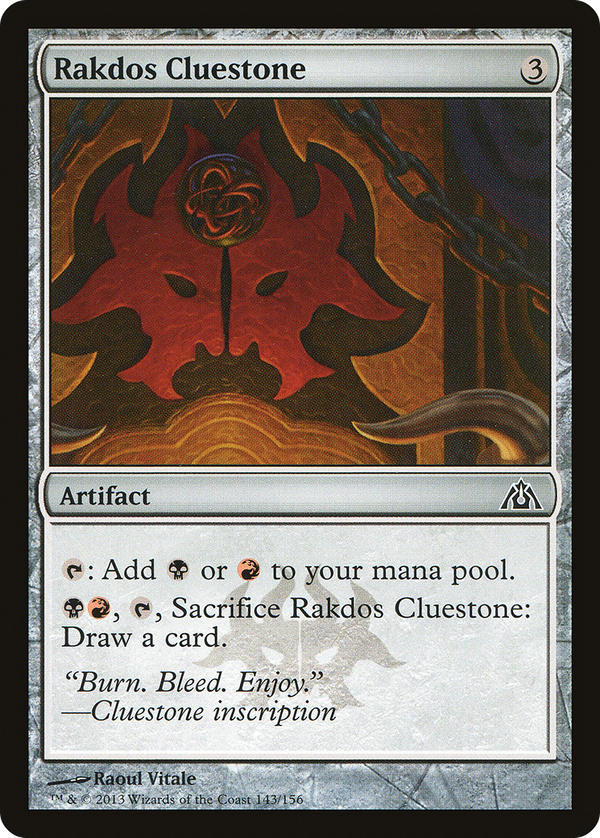
Rules text
 : Add
: Add  or
or  .
, , Sacrifice this artifact: Draw a card.
.
, , Sacrifice this artifact: Draw a card.