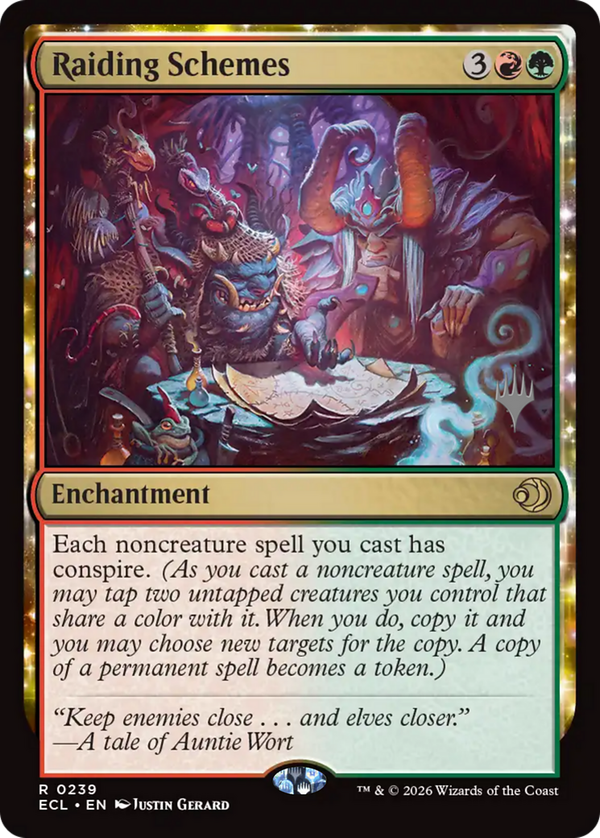
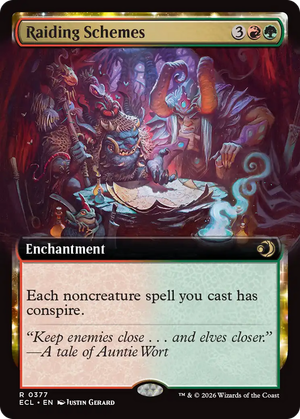
Raiding Schemes



Conspire was born as a per-card ornament: cast a spell, tap two creatures sharing a color with it, get a free copy that resolves independently. The design move here is to peel that ability off any single card and bolt it to a standing permanent, so every noncreature spell you cast inherits it and your board becomes a repeatable fork rather than a payoff you get once and lose. The price is paid in bodies, not mana, which sets up the central strain: developing a wide board to swing versus holding those creatures back to feed copies. Each trigger turns into a small referendum on whether a creature attacks or taps to double a spell. What sharpens this past ordinary card advantage is the copy's choose-new-targets clause: one removal spell answers two threats, one burn spell splits its reach across two faces, a bounce or a counter doubles without doubling the mana. Note that the color-share requirement lives on the spell being copied, not on this enchantment, so a mono-red board can conspire your red spells indefinitely; the pull toward both colors comes from wanting to enable red and green casts off the same battlefield. The build it demands is a strange one: a noncreature-dense shell that nonetheless fields a crowd of creatures whose colors line up with the spells worth forking, two deckbuilding pressures that usually run in opposite directions.