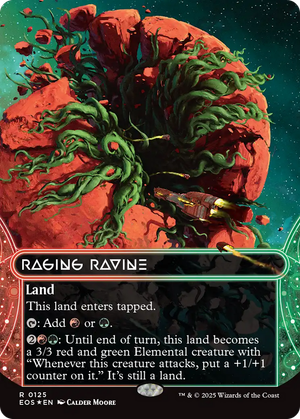
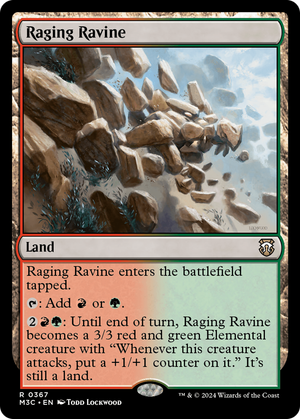
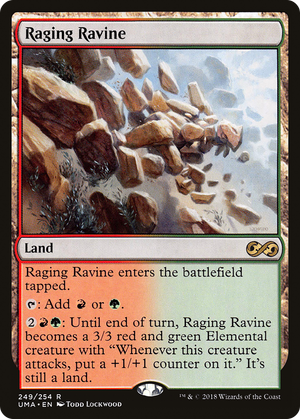
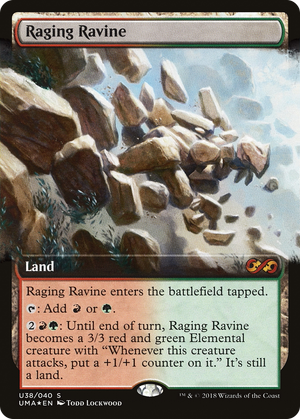
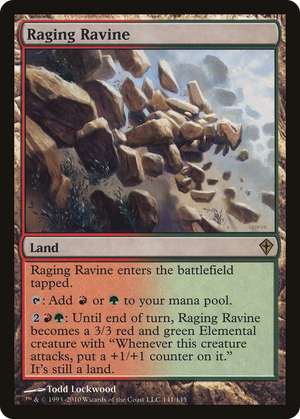
Raging Ravine
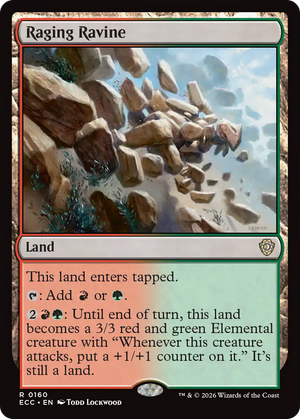
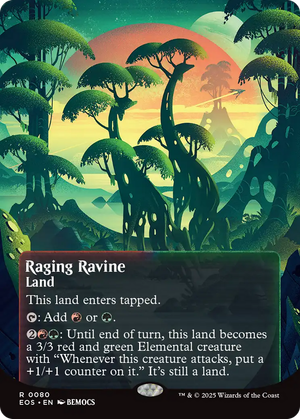
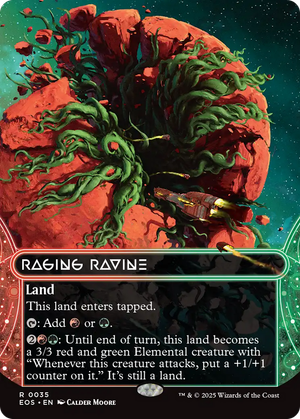
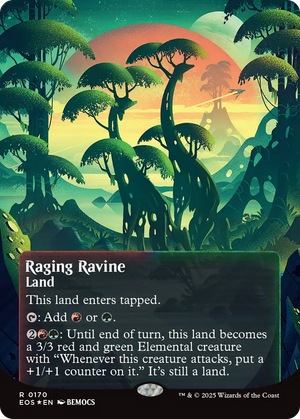
The Gruul entry in the manland cycle that solved a structural problem fair red-green decks kept hitting: the late game where extra lands stop mattering. A creature-land sidesteps the trade entirely, since a topdeck that taps for mana early can become a threat once the spells run dry, and it dodges sorcery-speed sweepers by sitting as an inert land until you commit mana to it. What separates this one from its dual-land siblings is the growth clause. Most manlands of its generation animate to a fixed body and stay there; this one rewards repeated aggression, gaining a +1/+1 counter every time it attacks, so a board stall it survives turns into a clock that escalates on its own. That trigger fires in the declare-attackers step, which is the wrinkle worth knowing: the counter lands before damage, so the very first swing is a 4/4, not a 3/3, and every subsequent attack adds another point that persists even after it reverts to a land at end of turn. The counter is the design lever that justifies the heavier activation; you are not paying for a static body but for a creature that grows itself out of profitable blocks. The enters-tapped clause is the standing tax on all of this, the tempo cost that keeps a land this flexible from being a free inclusion. It is the archetype's manabase and its finisher in the same slot, which is the entire reason creature-lands earn their deckbuilding cost.
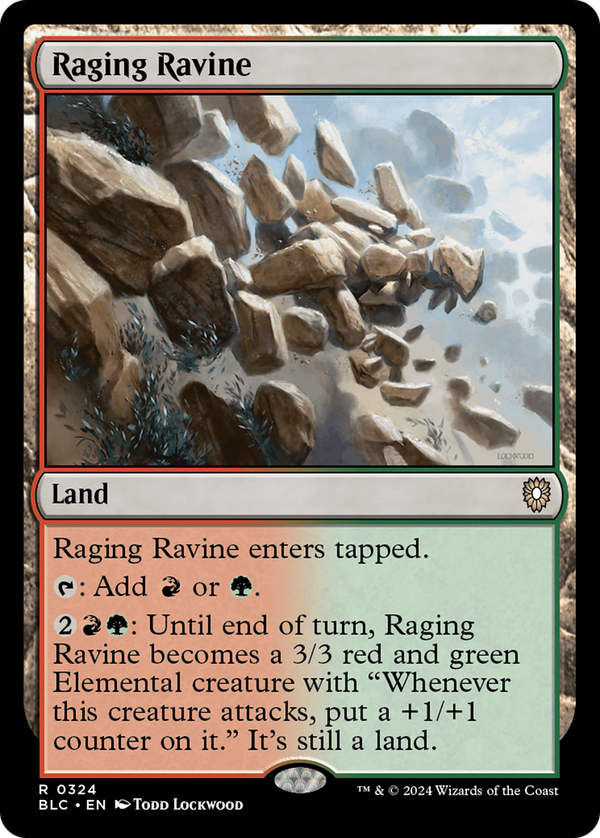
Rules text
 : Add
: Add  or
or  .
.
 : Until end of turn, this land becomes a 3/3 red and green Elemental creature with "Whenever this creature attacks, put a +1/+1 counter on it." It's still a land.
Format Status
More formatsFewer formats
Other printings
- Lorwyn Eclipsed Commander#160
- Edge of Eternities: Stellar Sights#80
- Edge of Eternities: Stellar Sights#35
- Edge of Eternities: Stellar Sights#170
- Edge of Eternities: Stellar Sights#125
- Modern Horizons 3 Commander#367
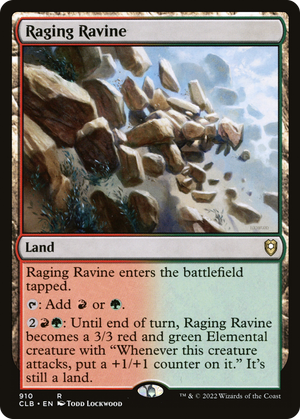
- Commander Legends: Battle for Baldur's Gate#910
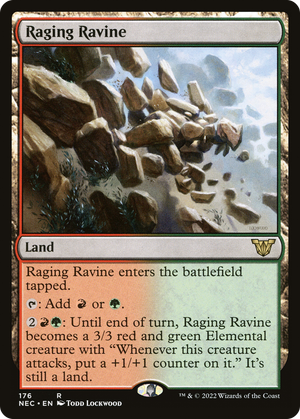
- Neon Dynasty Commander#176