Quicksilver Wall


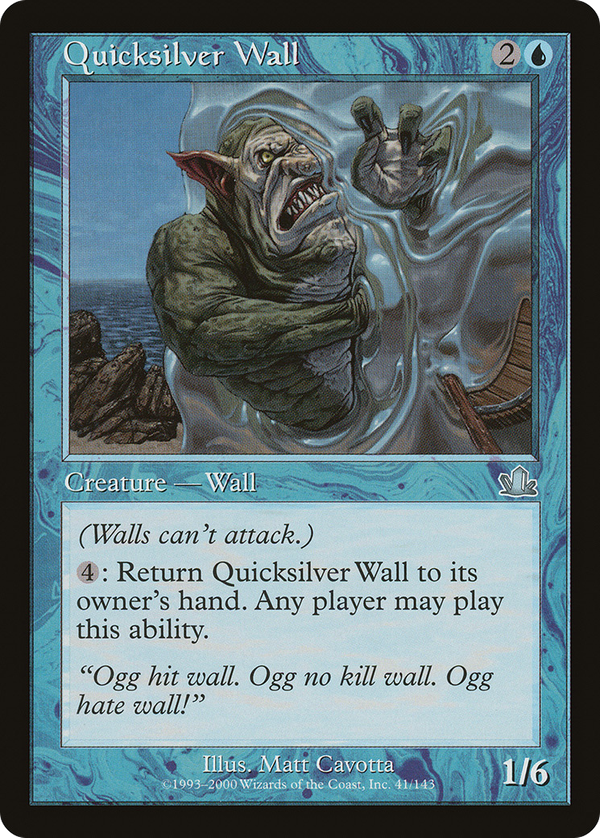
A 1/6 body parked behind Defender is ordinary enough; the four-mana bounce that any player at the table can press is the genuine oddity. Most defensive permanents belong wholly to their controller: they sit, they block, the opponent works around them. Here the controller can pay four to reset the wall, but an attacker can spend the identical four to send it back to hand and clear a lane before combat. That shared permission turns a static blocker into a knob with two hands on it, a piece of table politics from an era well before the multiplayer-design vocabulary for that existed. The toughness is the part that makes the symmetry bite: six is enough to wall off most early ground offense, so the wall is worth removing, which means it is worth an opponent paying to remove. A blocker is only as good as your exclusive control over it, and this one quietly surrenders that exclusivity for a price both players know. It belongs to a small family of early-era experiments with abilities whose gate opens to the whole game rather than its owner, asking whether a defender you do not fully command is still a defender at all.
Rules text
 : Return this creature to its owner's hand. Any player may activate this ability.