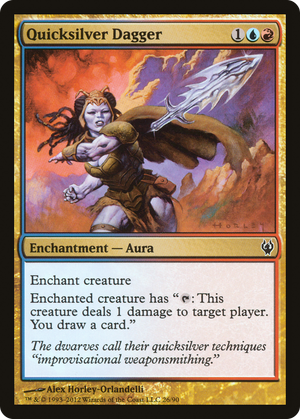
Quicksilver Dagger



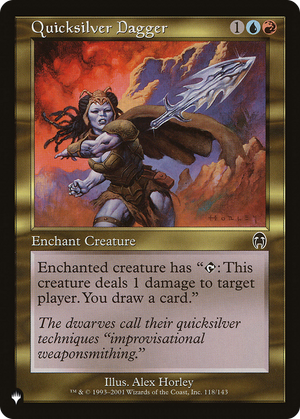
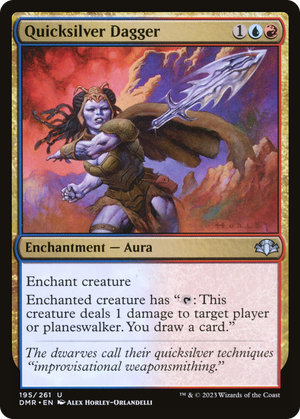
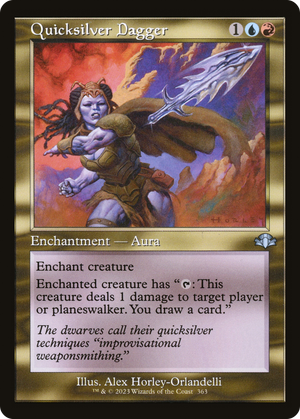
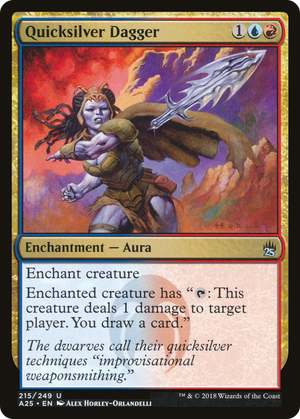
Strap a repeating cantrip onto any creature with a tap symbol and you have built a draw engine that pings: every untap step turns one creature into a card and a point of reach. The pairing of colors tells you exactly what Izzet was being asked to be at the turn of the millennium, a guild not yet named but already defined by burn that replaces itself. The card's real tension is the one it shares with every Aura: it doubles down on a single creature, so a removal spell two-for-ones you, taking both the dagger and its host. That risk is the price for an effect that, left alone, snowballs hard, because the activation costs nothing but the tap and refills your hand each time it fires. The choice to point the damage at players or planeswalkers rather than creatures is the load-bearing restriction: this is not a removal tool, it is an inevitability tool, a way to convert board stalls into card advantage and chip damage rather than to trade. It reads like a finisher for a deck that wants to draw its whole library and win by attrition, which is precisely the kind of grindy blue-red shell that has reinvented itself in every era since.
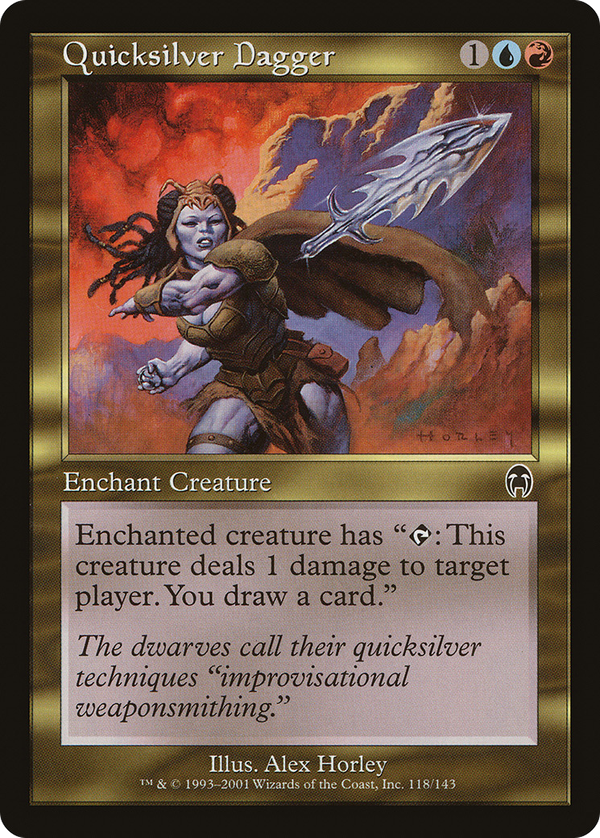
Rules text
 : This creature deals 1 damage to target player or planeswalker. You draw a card."