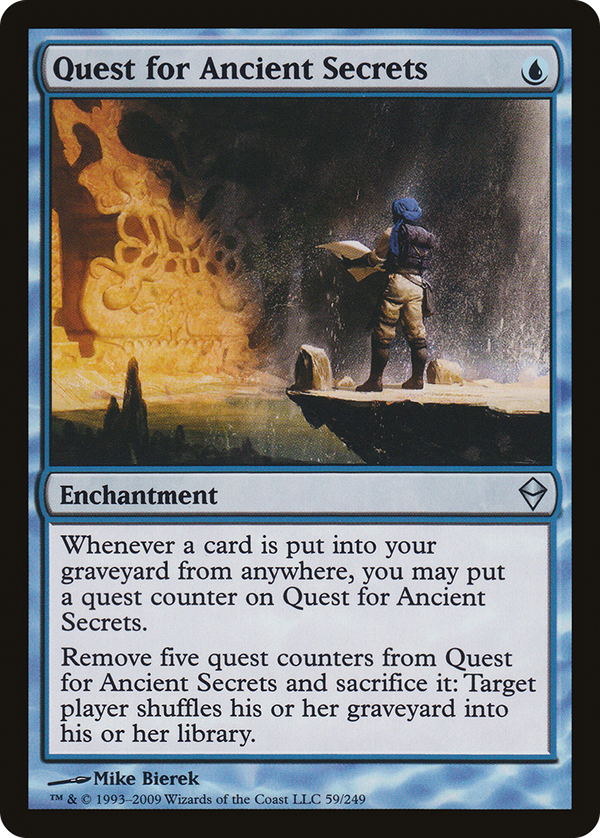
Quest for Ancient Secrets

The Quest cycle ran on a shared engine: count something you were already doing, then cash the tally for a payoff worth more than the cost. This one counts cards hitting your graveyard, the most passive trigger in the family, and pays out the narrowest reward: a graveyard shuffled back into a library. As a self-mill engine it does nothing you want, since the cards you milled get folded back into your deck at random. The honest reading lives in the targeting clause: it shuffles target player's graveyard, so the real audience is anyone trying to strip a graveyard of resources. Reanimation, flashback, delve, dredge, threshold: pointing the activation across the table clears all of it at once and reshuffles the variance back into their deck besides. The friction is the count. Five counters is a long climb for a fight you usually need won faster, and there is no acceleration beyond playing more graveyard-fillers, which tend to be your own self-mill or fetch effects feeding a payoff aimed at an opponent. It is graveyard hate built as a slow-burn enchantment instead of an instant, an unusual chassis for an effect the game almost always wants at flash speed and at a moment of its own choosing. The structure is the curiosity; the rate rarely justifies the wait.