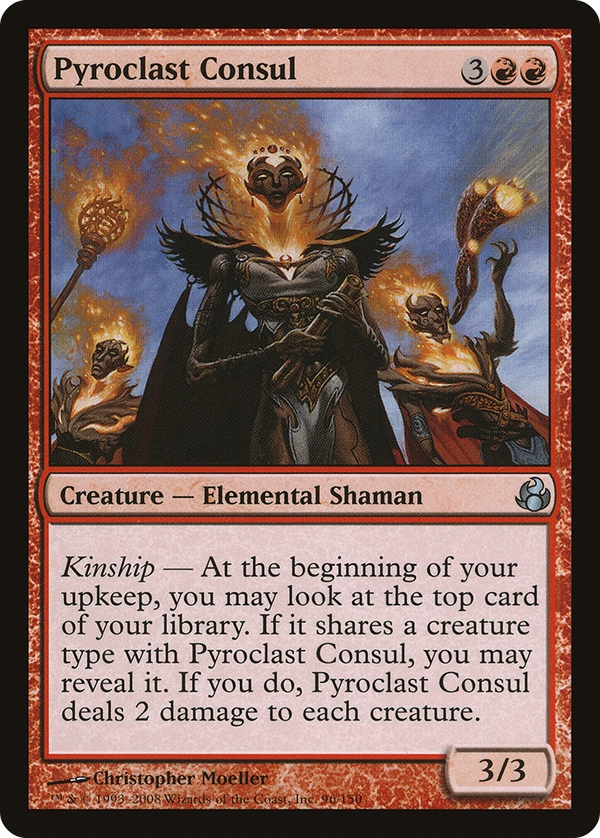
Pyroclast Consul

Kinship asked players to build around a coin flip that you could weight but never guarantee, and this is the mechanic in its most aggressive mode: a board sweeper that fires at the start of your upkeep, after you untap but before you draw, if the gamble pays. The two damage to each creature is the part worth dwelling on, because it includes itself. The 3/3 body survives its own trigger, which means the deck around it leans on a board of higher-toughness Elementals or Shamans while the smaller things across the table die. That self-inclusive symmetry is the design tension: every trigger is a pinger that judges your own creatures as harshly as the opponent's, so the build has to be a tribal aggro shell whose creatures sit above the burn line. The shared-creature-type clause is what powers the gamble, and it rewards stacking a narrow tribe so the top card is likely to match. What makes the card awkward rather than oppressive is the lack of control: you peek, you reveal or you don't, but you can never demand the trigger when you need a sweep. It is recurring removal that arrives on its own schedule, contingent on a library you have stacked toward one or two creature types. The whole archetype around it is an exercise in raising the floor of a probabilistic mechanic until the upside shows up often enough to matter.