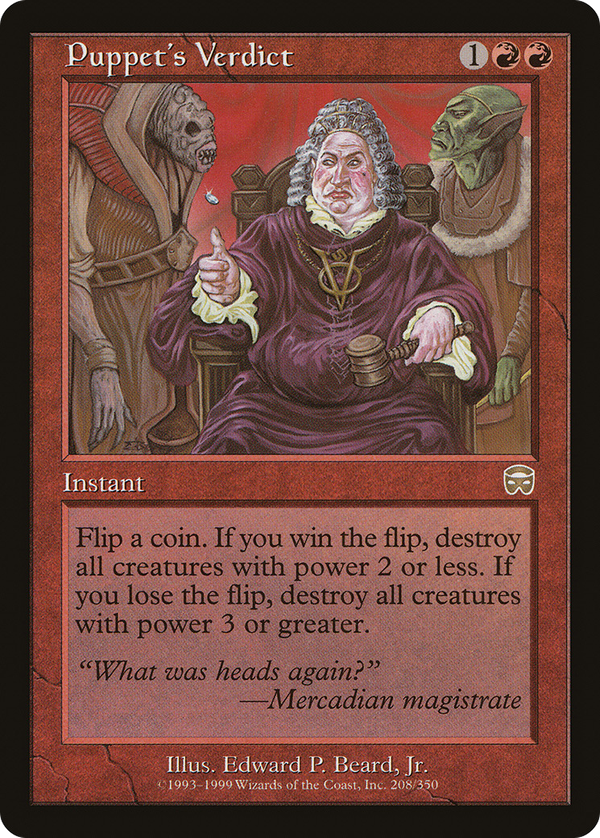
Puppet's Verdict


Coin-flip cards live or die by how the random outcome maps onto board states, and this one folds two opposite sweepers into a single fifty-fifty. The trick is that you control the timing. Winning the flip clears the small creatures; losing it clears the big ones; the play is to cast it when the battlefield is lopsided enough that one result wins the game outright and the other still does something rather than nothing. The design pretends to be symmetric and isn't: whoever deploys around the split decides which half of the coin is upside and which is merely survivable. A board of tokens facing a lone fattie reads very differently depending on whose creatures sit where, and the real work happens before the flip, in how you engineer that asymmetry. That turns a board wipe into a bluff and a dare, an effect priced for the gamble rather than the certainty. The randomness is the point rather than a flaw, an early-era expression of red's willingness to trade reliability for variance, the same impulse behind Mana Clash and the rest of red's coin-flip lineage. The wager is the cost itself: a guaranteed two-sided Wrath of God at this rate would never sit in red, so the coin is the tax red pays to touch the effect at all.