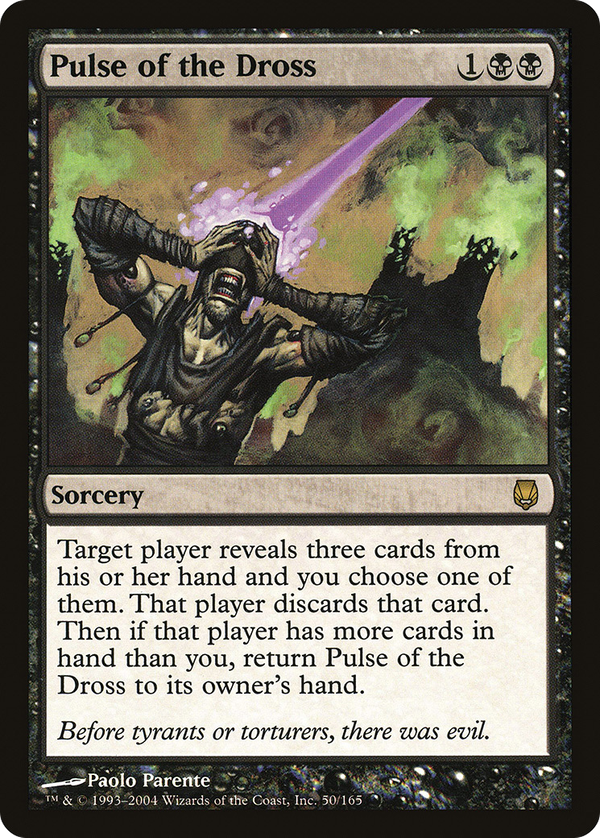
Pulse of the Dross


Black's discard had a structural ceiling that Mind Rot and its kin always ran into: once your opponent is empty-handed, the spell is dead in your hand, a topdeck that does nothing. The recursion clause flips that math by tying the spell's return to the very condition that makes discard useful. As long as the target holds more cards than you do, this comes back, so it stops being a one-shot and becomes an attrition engine that grinds a full grip down to parity, then politely retires once the resource race is even. The reveal-three-and-you-choose framing is the half that does the discipline: the opponent loads the choice, but you pick the card that hurts, which means the worst case is still a meaningful answer rather than a random pitch. That combination, self-replicating only while you are behind on cards, makes it a control mirror tool by nature. Against an empty hand it is inert; against a hoarder it never stops coming. It sits in a small early-era design experiment in spells that recur based on a board-or-hand asymmetry rather than a flat mana cost, and of that group this is the one aimed squarely at the long game, where the slow bleed of a recurring discard outlasts decks built to refill.