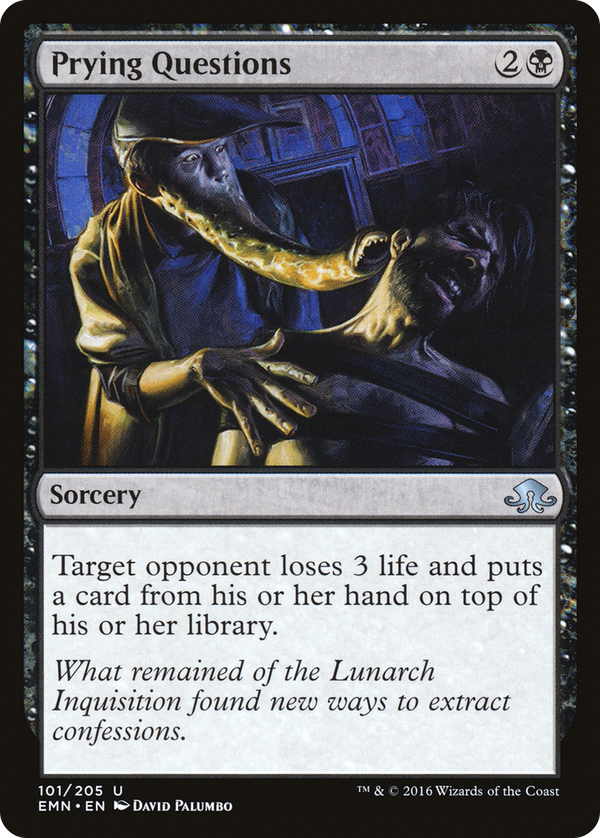
Prying Questions


The trade here is deliberately lopsided: spend a card and three mana to knock an opponent for three life and force them to bank a card on top of their library. The tucked card never leaves their possession for good; it returns on their next draw, so the disruption costs them a single turn at most, and the life loss is the only durable result. The design's central weakness is that the opponent chooses which card goes back, so they shelve their worst spell and keep their best. The effect only sharpens when the top of an opponent's library matters to someone other than them: a mill effect to bin the locked-in card before it returns, or any engine that profits from a known, predictable draw being denied. (Note that the card sits on top of the library, not in hand, so discard-style disruption cannot reach it; you need to shuffle or mill it instead.) As a pure resource exchange this is a one-for-one at a poor rate, the kind of soft disruption that only earns a slot in a shell built to punish a stacked library rather than one that merely wants to stall. The three points of life loss read as a sweetener stapled on to keep the effect from being purely reactive: a small clock for an attrition or control deck whose disruption otherwise does nothing to end the game.