Providence


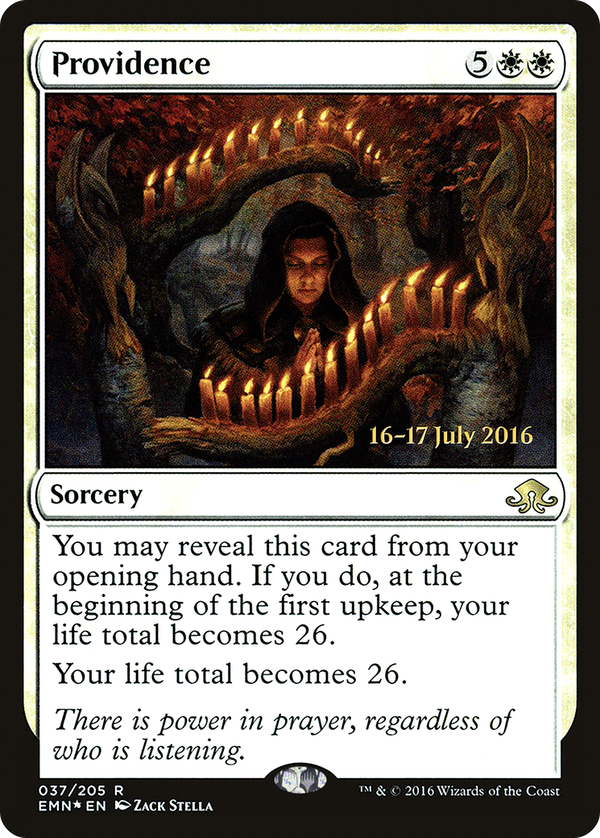
Consider what seven mana usually buys in white: a sweeper, a finisher, something that ends games. This sets your life total to exactly 26, which means it gains the most life precisely when you are at your most desperate (25 life if you have been beaten down to 1, only a handful if you have barely been touched). That is the whole design joke, and it is why the hardcast number rarely matches what you want: a fixed ceiling is a poor reward when the games where you need the most life are also the games where you can least afford and a full turn doing nothing else. The reveal-from-hand line is the card's real reason to exist: announce it on turn zero and your total snaps to 26 at the first upkeep for no mana at all. Free and hardcast both deliver the same flat 26; the only variable is whether you paid for it, and whether you still had the opening-hand window open. The casting mode is the consolation prize, the way to still play the card once you have drawn it past turn one rather than held it from the start. Read as design, it is a curio built on a deliberately strange symmetry: a free top-of-game effect and an expensive late-game one converging on a single arbitrary number that is meaningful only on turn zero and almost never afterward.