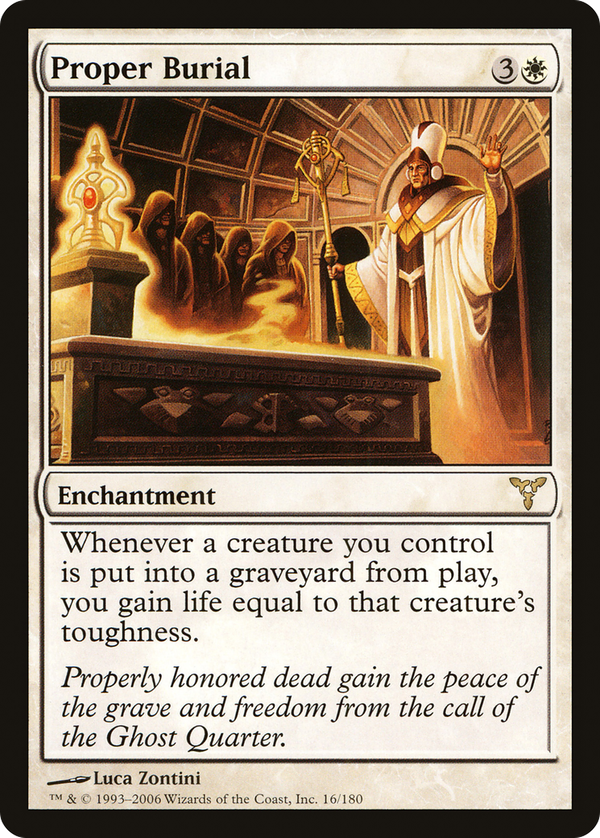
Proper Burial


The aristocrat payoff before aristocrats were a recognizable archetype. It pays you for the same event most sacrifice decks already want to engineer (creatures dying), but it does it through a lens nobody else uses: toughness, not power, not a flat number, not card draw. That choice matters more than it looks. A wall-bodied chump blocker that trades into an attacker hands you a fat life swing on death; a glass-cannon attacker with one toughness barely registers. So the card quietly rewards a board built on durable bodies, and it stacks: feed a sacrifice outlet a board of high-toughness creatures and the life total climbs in chunks that outpace most aggressive clocks. The catch is that none of this touches the board itself. It neither protects your creatures nor closes the game; it converts attrition into a cushion and asks the rest of the deck to do the killing. That made it an awkward fit in early-era design, when life gain alone rarely justified a slot, and the sacrifice engines that would have made it sing were thinner on the ground. It reads now as a structural sketch of the lifedrain-aristocrats payoff that later designs filled in with bodies and recursion attached, a passive enchantment doing one half of a job that eventually became a whole archetype.