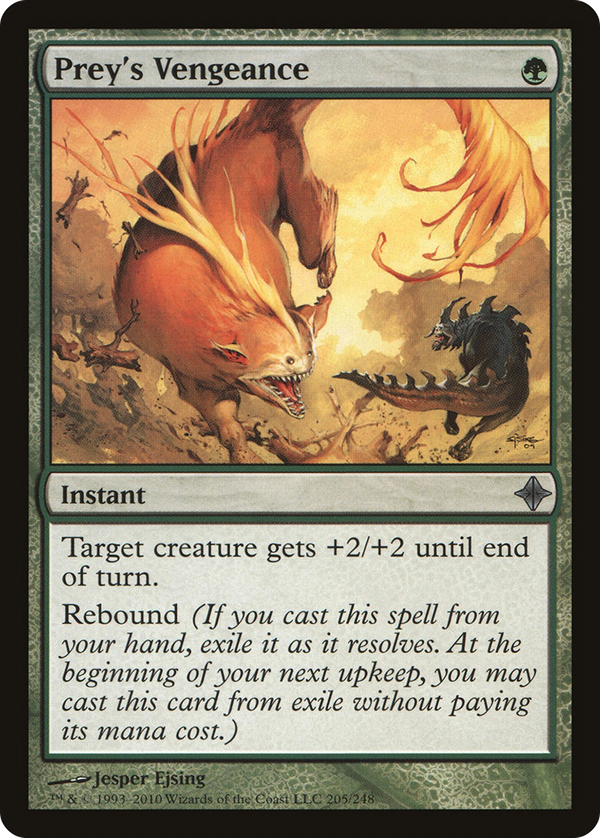
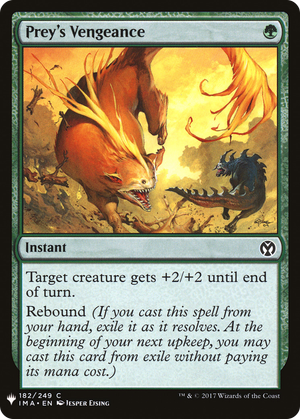
Prey's Vengeance

Pay for a single combat trick and get two of them, one turn apart. That is the whole proposition, and rebound is what turns a one-mana pump spell into something an aggressive deck genuinely wants to draw. The first cast lands the moment you need it, mid-combat or to push a blocked attacker through; the second arrives on your next upkeep, free, before you have committed any other resources, letting you bank it for the turn's first profitable swing or hold up the mana you would otherwise have spent. Two-for-one card advantage out of a green one-drop is the kind of thing the color rarely gets, and rebound hides it inside what reads as a vanilla +2/+2. The cost of that advantage is patience: the rebounded card can only be cast in your upkeep, so it cannot answer this turn's block, and you cast it as a fresh spell choosing a new target, which means the upside lives or dies on whether you still have a creature worth pumping a full turn later. That tension (instant-speed flexibility now versus a fixed, free trick a turn away) is the design at work. It rewards a board that keeps pressure on the table long enough to spend both halves, and it punishes the spot where you cast the first copy on a creature that does not survive, then arrive at your upkeep with nothing left to point the second at.