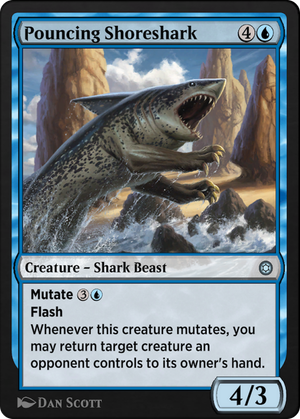
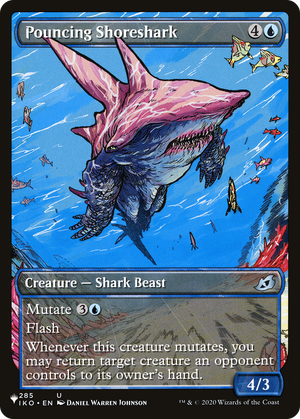
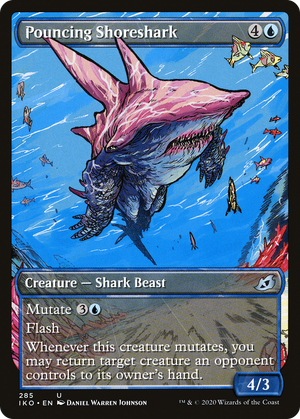
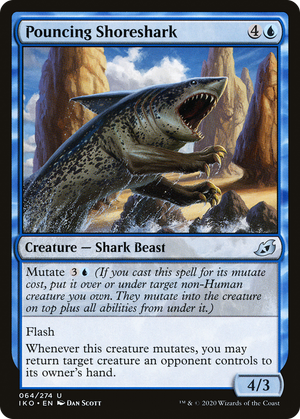
Pouncing Shoreshark


Bounce has always come with an expiration date: a creature returns to your board and does its job again, so a Man-o'-War effect buys you a turn and then stops. Keying the return-to-hand to the mutate event instead of the cast rewrites that math. Cast it for its mutate cost, stack it onto a creature already on your board, and the trigger fires; but because mutate stacks repeatedly, every later mutation onto that same pile fires the bounce again. A one-shot tempo tool becomes a tax the opponent pays each time the stack grows. Flash is what turns the 4/3 body into a trap: hold it, wait for a swing or a stack decision, then mutate at instant speed and unwind their tempo when it stings most. The bounce itself reads modestly (one creature, no card advantage, a tap-out reset), which is exactly why the recursion matters more than the rate. The trigger keys off the act of mutating, not off which card lands on top, so the controller can bury this under a stronger face and still collect the return, or lead with the body when the board just wants a threat. That flexibility is the point: it is less a finisher than an engine that eats an opponent's board one piece at a time, refreshing the swing every time you feed the stack.
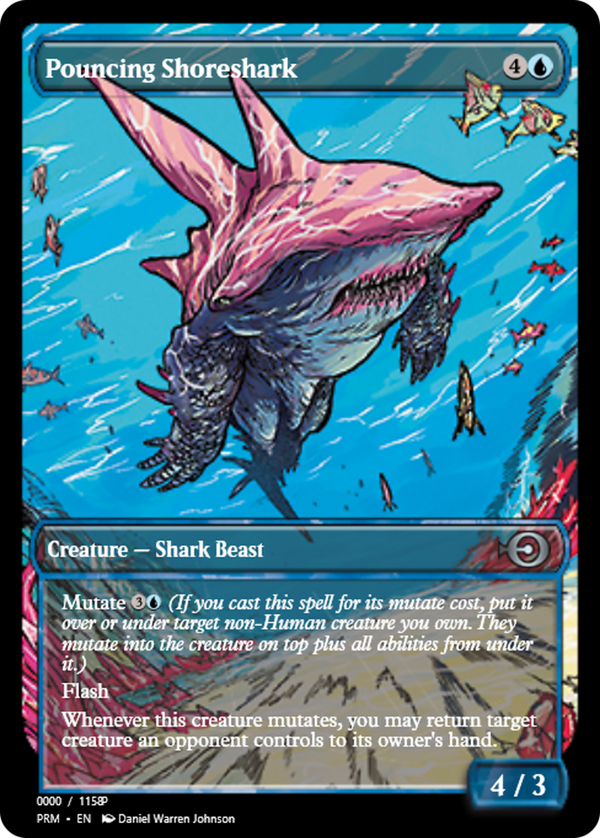
Rules text
 (If you cast this spell for its mutate cost, put it over or under target non-Human creature you own. They mutate into the creature on top plus all abilities from under it.)
Flash
Whenever this creature mutates, you may return target creature an opponent controls to its owner's hand.
(If you cast this spell for its mutate cost, put it over or under target non-Human creature you own. They mutate into the creature on top plus all abilities from under it.)
Flash
Whenever this creature mutates, you may return target creature an opponent controls to its owner's hand.