Plunder


Stone Rain priced itself at three mana to blow up a land; this asks for five if you cast it honestly, with the trade-off being targeting flexibility, the ability to hit an artifact or a land as the board demands. That rate is deliberately bad on its own, and the card is not built to be cast on its own. Suspend is the whole transaction: pay  on turn two, exile it under four time counters, and the destruction lands four upkeeps later for nothing more than that early-game investment. The mechanic reframes a clunky midgame answer as a cheap, scheduled commitment that resolves on its own clock. The friction lives in the delay: by the time the last counter falls and the spell goes on the stack, the opponent has had four turns to read the threat coming and reshape the board so the eventual destruction matters less. What they cannot lock down in advance is which permanent it lands on, because the target is not chosen until the spell is actually cast off the final time counter, not at the moment you exile it back on turn two. That deferred choice is what keeps the patience honest: you spend a small price early in exchange for an answer that still gets to point at whatever has become the problem. It rewards the slow, grinding red deck that wants to commit a turn-two seed and let the clock do the dismantling, trading immediacy for a price the late game can no longer afford.
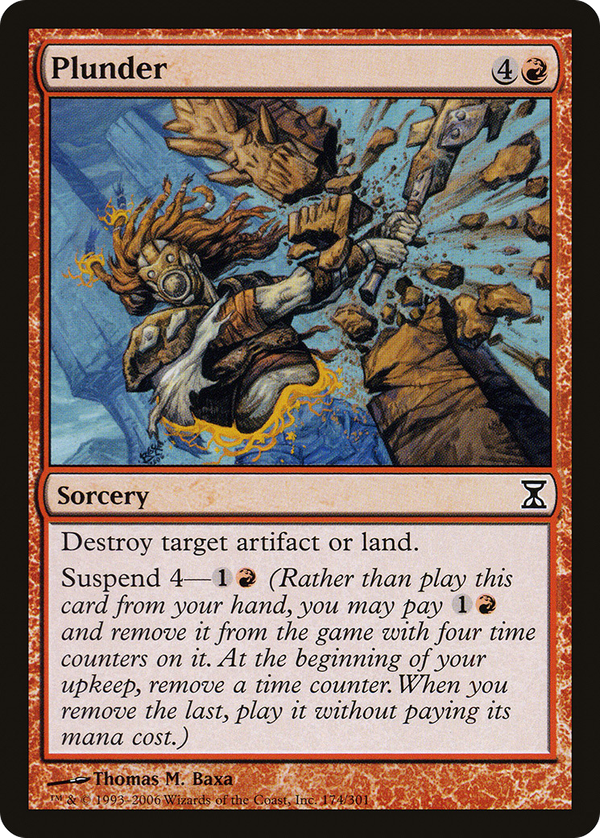
Rules text
(Rather than cast this card from your hand, you may pay and exile it with four time counters on it. At the beginning of your upkeep, remove a time counter. When the last is removed, you may cast it without paying its mana cost.)