Planeswalker's Mirth


Lifegain tied to a random reveal is a strange place to put your white mana, and the math underlines why this never found a home. Four mana to flip over one card chosen at random from an opponent's hand, gaining life equal to its mana value, means the payoff floats between zero (they hit a land) and whatever happens to be their most expensive spell. You get neither the information of a targeted hand-look nor the reliability of a fixed life total; the card is built around variance in both directions, and white has rarely had a worse currency to spend repeated four-mana activations on than a coin-flip life swing. The randomness is the whole problem: because the card is revealed at random rather than chosen, you cannot steer it, but neither can the opponent steer it away from their bombs, so what could have been a read on their hand collapses into noise that also gives you nothing actionable. The opponent loses no card either, so it never functions as disruption. What remains is a slow, expensive enchantment whose ceiling is a single big life gain and whose floor is nothing at all. It belongs to a brief design moment when life gain was treated as a payoff worth gating behind heavy costs, before the format math made clear how little raw life mattered against the threats it was supposed to outlast.
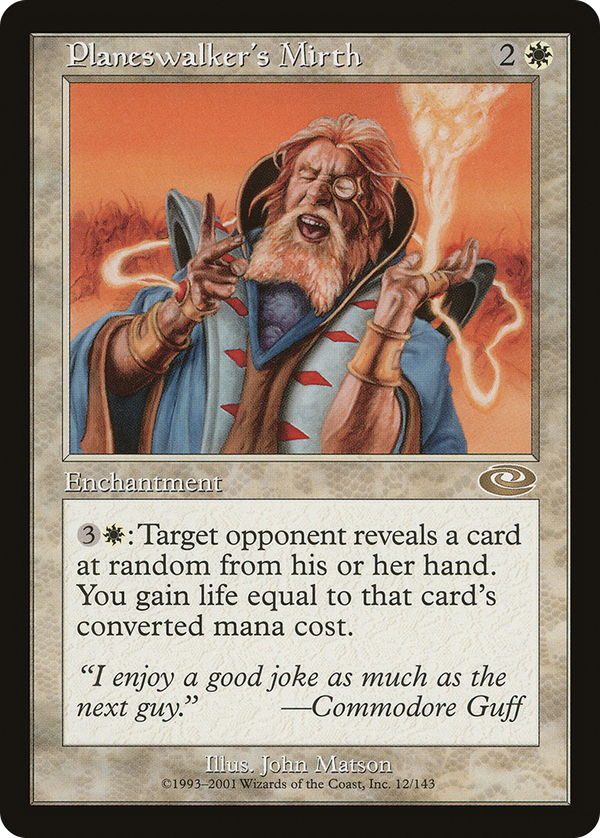
Rules text
 : Target opponent reveals a card at random from their hand. You gain life equal to that card's mana value.